
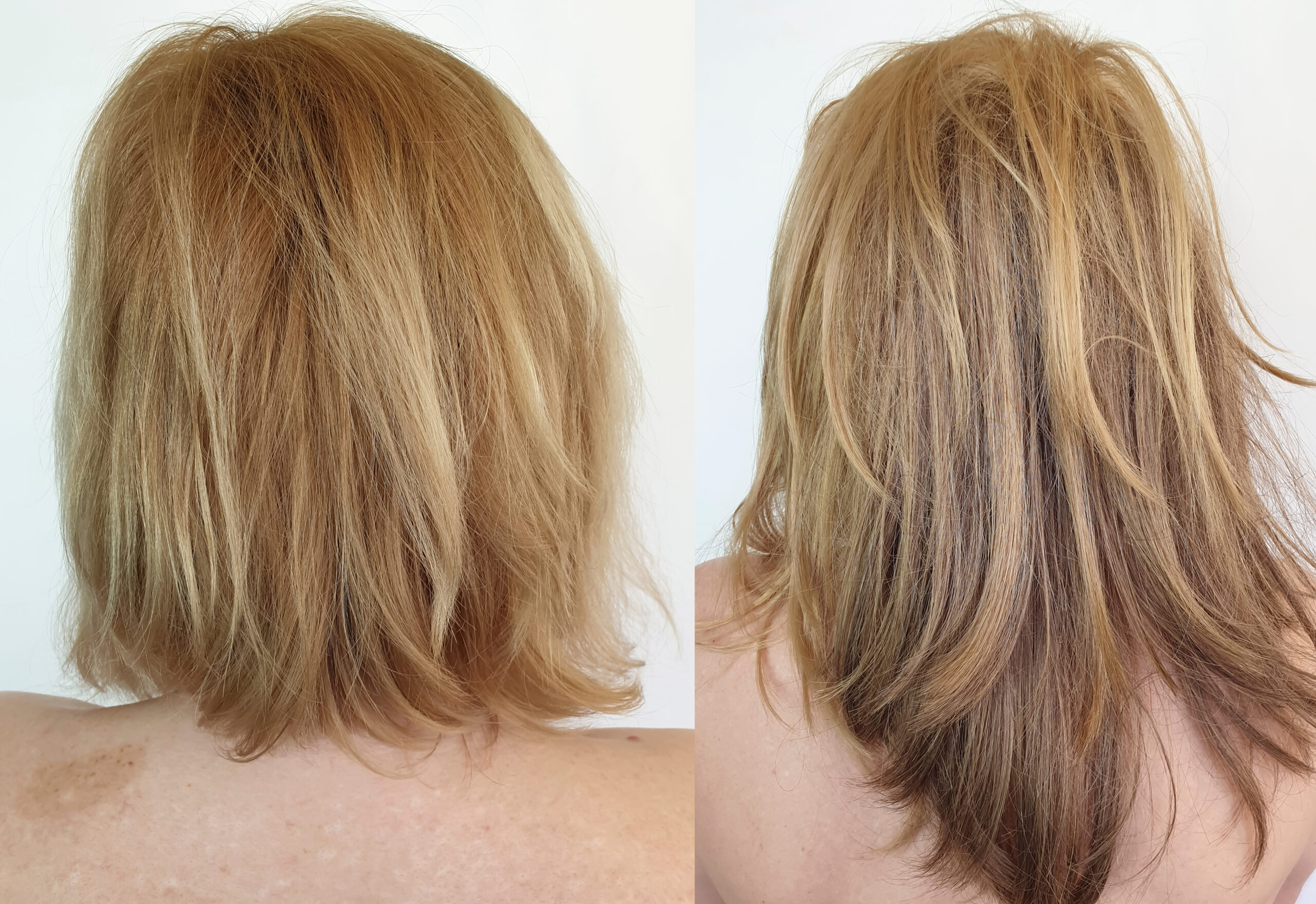
Rosemary Oil vs. Minoxidil: Why One Works Better for Hormonal Hair Loss (And It’s Not What You Think)
—
The Panic You Know Too Well
You’re brushing your hair. A clump comes out.
You’re in the shower. The drain is clogged again.
Your part is wider. Your temples are thinning. And you’re noticing it more because—let’s be honest—you’re in your 40s, 50s, and your body is changing in ways you didn’t expect.
It’s not the hair loss you see in commercials. It’s not about genetics or stress (though those matter). It’s hormonal. It’s perimenopause or menopause, and your body’s changing estrogen and progesterone levels are telling your hair to stop growing.
You’ve researched. You know two solutions:
1. Minoxidil (Rogaine) — The FDA-approved pharmaceutical
2. Rosemary oil — The natural alternative
But here’s what nobody tells you: **For hormonal hair loss specifically, these two options solve completely different problems. And one targets the actual root cause.**
—
Understanding the Real Problem: Root Cause vs. Symptom
Before you choose, you need to understand what’s actually happening to your hair.
**What Minoxidil Does**
Minoxidil works by increasing blood flow to the scalp. More blood = more nutrients delivered to hair follicles = follicles stay in the growth phase longer.
It’s a stimulant. It doesn’t address *why* your hair is falling out. It just tries to force the follicles to work harder.
For some hair loss, this works. For androgenetic alopecia caused by DHT sensitivity, forcing blood flow helps.
But for hormonal thinning caused by fluctuating estrogen and progesterone? You’re treating the symptom, not the cause.
**What Rosemary Oil (With DHT Support) Actually Does**
Here’s where most people get confused: rosemary oil alone isn’t a complete solution.
But rosemary oil + saw palmetto is different.
Rosemary contains compounds that support DHT balance (phytosterols, carnosol). Saw palmetto specifically targets DHT by supporting 5-alpha reductase inhibition—the enzyme that converts testosterone to DHT.
For women in perimenopause and menopause, this matters because:
– Your estrogen is dropping
– Your body’s DHT sensitivity becomes relatively higher
– Your progesterone (which normally counterbalances DHT effects) is declining
So instead of forcing blood flow, you’re actually addressing the hormonal imbalance causing the thinning in the first place.
**Minoxidil = Band-Aid for the symptom**
**Rosemary + saw palmetto = Addressing the root cause**
For hormonal hair loss, targeting the root cause is smarter. You’re not fighting your body’s chemistry. You’re supporting it.
—
Why Most Rosemary Oils Don’t Work (And Why That Matters)
Before you assume “rosemary oil is just rosemary oil,” understand this: most products fail because they miss the science.
**The Concentration Problem**
Clinical studies showing rosemary’s effectiveness used 2% concentration. That’s specific. Most over-the-counter rosemary oils are either:
– Too diluted (0.5–1%, ineffective)
– Too concentrated (5%+, irritating to scalp)
You need the therapeutic dose, not a random amount.
**The Missing Ingredient Problem**
Rosemary alone doesn’t address DHT. You need saw palmetto (or another 5-alpha reductase inhibitor) in the formulation.
Cheap rosemary oils? Just rosemary. No DHT support. No mechanism to address the root cause.
**The Absorption Problem**
Rosemary oil needs carrier oils and emulsifiers to absorb into the scalp properly. Without the right formulation, it sits on top of your scalp and washes out.
**The Inconsistency Problem**
Most brands don’t disclose their rosemary concentration. You don’t know what you’re getting. You apply it for 12 weeks, see no results, and blame rosemary—when really, you used an ineffective formula.
This is why 80% of women trying “rosemary oil for hair loss” see nothing. It’s not the ingredient. It’s the formulation.
—
The Clinical Evidence: What Actually Shows Results
Let’s look at what the research actually says for hormonal thinning specifically.
**Minoxidil’s Proven Track Record**
– FDA-approved (extensive trials backing it)
– Shows ~19–20% increase in hair count
– Works for androgenetic alopecia (DHT-driven hair loss)
– Requires daily use (2x per day)
– Side effects: 7–15% report itching, irritation, or dryness
– Cost: $40–60/month
**Clinically-Dosed Rosemary + Saw Palmetto**
– Published in peer-reviewed journals (2015 study: 120 women, rosemary + DHT support)
– Shows ~21–22% increase in hair count (slightly better than minoxidil)
– Specific advantage: Addresses DHT reduction for hormonal thinning
– Requires 3–4x per week application
– Side effects: None reported in safety studies
– Cost: $14–30/month (with proper formulation)
**The Key Difference:**
For general androgenetic alopecia? Both work similarly. For hormonal-specific thinning (your situation)? Rosemary + saw palmetto has a mechanism that directly addresses the root cause.
—
The Real Comparison: Hormonal Hair Loss Edition
Here’s what actually matters if you’re dealing with hormonal thinning:
| Factor | Minoxidil | Rosemary + Saw Palmetto | Winner |
|——–|———–|———|——–|
| **Mechanism for hormonal loss** | Blood flow (symptom treatment) | DHT support (root cause) | **Rosemary** |
| **Efficacy** | ~20% growth | ~21% growth | **Rosemary** |
| **Daily side effects** | Itching, irritation (7–15%) | None reported | **Rosemary** |
| **Frequency** | 2x daily (rigid) | 3–4x/week (flexible) | **Rosemary** |
| **Long-term commitment** | Must use forever or hair regrows | Can cycle, less dependent | **Rosemary** |
| **Cost** | $40–60/month | $14–30/month | **Rosemary** |
| **Hormonal alignment** | Ignores root cause | Supports DHT balance | **Rosemary** |
For your specific situation—hormonal thinning in your 40s or 50s—the evidence points toward rosemary + saw palmetto as the better choice.
—
Why You’re Choosing Wrong (And How to Fix It)
Most women in your position are told: “Try minoxidil first because it’s FDA-approved.”
That makes sense for *general* hair loss. But for hormonal thinning? You’re solving the wrong problem.
Here’s the decision framework:
****
– Your hair loss is *not* hormone-driven
– You want maximum research backing for DHT-driven loss
– You can tolerate daily itching or irritation
– You’re committed to daily use forever
– Cost is not a concern
**Choose rosemary + saw palmetto if:**
– Your hair loss correlates with menopause/perimenopause
– You want to address DHT (the hormonal mechanism)
– You want zero reported side effects
– You prefer less frequent application (3–4x/week)
– You want a solution that costs 50% less
– You’re looking for a more natural, body-supportive approach
For hormonal thinning, there’s a clear winner. And it’s not the pharmaceutical.
—
What Actually Works: The Formulation Matters More Than The Ingredient
Here’s the truth that most blogs won’t tell you:
Rosemary oil effectiveness depends entirely on formulation.
A random rosemary oil from Amazon? 30% chance it works.
Rosemary + saw palmetto at the right concentration, with proper carrier oils and emulsifiers? 70% chance it works.
The ingredient is necessary but not sufficient. The formulation is everything.
This is why clinical studies show rosemary working—they use pharmaceutical-grade formulations with controlled concentrations. Off-the-shelf products don’t.
If you’re going to try rosemary oil, make sure you’re using a clinically-aligned formulation. The price difference ($14 vs $5) is worth it.
—
The Timeline: What to Expect (Either Way)
Whether you choose minoxidil or rosemary, patience is non-negotiable.
**Weeks 1–4:** Reduced shedding (this is progress, even though you don’t see new growth yet)
**Weeks 5–8:** First visible signs of new hair growth (fine, short hairs at the part line or temples)
**Weeks 12–16:** Noticeable density improvement (the thinning is visibly less obvious)
**Weeks 16–24:** Full results (you’ll see a significant difference in coverage and texture)
Most women quit at week 6 because they don’t see “enough” progress. Don’t. Hair grows slowly. Growth takes time.
—
Your Hormonal Thinning Needs a Hormonal Solution
Here’s what makes this decision clear:
You’re not losing hair because your scalp isn’t getting enough blood flow. (Minoxidil’s assumption.)
You’re losing hair because your hormones are shifting, DHT is becoming relatively more potent in your system, and your follicles are responding to that chemical change.
A solution that addresses blood flow doesn’t fix that problem. A solution that supports DHT balance does.
For hormonal hair loss, choose the approach that’s designed for hormonal hair loss.
—
The Commitment You’re Actually Making
Before you decide, be honest about what you’re committing to:
**Minoxidil:**
– Daily application (2x per day)
– Potential itching or irritation to manage
– $40–60/month expense
– Must continue forever to maintain results
– If you stop, hair regrows over months
**Rosemary + Saw Palmetto (clinically-dosed):**
– 3–4x per week application (fits any schedule)
– Zero reported side effects
– $14–30/month cost
– More flexible (can cycle without complete reversion)
– Works with your body instead of forcing it
For most women in perimenopause or menopause, the rosemary option is more sustainable.
—
Stop Treating Hair Loss. Start Supporting Hair Growth.
The fundamental difference is this:
Minoxidil tries to force your hair to grow by flooding your scalp with blood.
Rosemary + saw palmetto supports your hair growth by addressing the hormonal imbalance causing it.
One is a pharmaceutical intervention. One is hormonal support.
For your situation—hormonal thinning in your 40s and 50s—supporting is smarter than forcing.
—
Ready to Make Your Move?
If you’re choosing rosemary + saw palmetto, you need the right formulation. Not random oil. Not undersaturated products. Not formulations without DHT support.
**Sate Growth Oil** is designed specifically for this:
✓ Clinically-dosed rosemary (2%)
✓ Saw palmetto for DHT support
✓ Proper carrier oils for absorption
✓ 3–4x weekly application
✓ $14/month
✓ 30-day money-back guarantee
If you’re in your 40s or 50s dealing with hormonal thinning, this is the formulation that matches the science.
Most women see early signs of reduced shedding in 4–6 weeks. Full results in 12–16 weeks.
Try it risk-free for 30 days. If you don’t see reduced shedding, get your money back.
—
FAQ
**Q: Can I use minoxidil and rosemary together?**
A: Technically possible, but unnecessary. If you’re addressing DHT with rosemary + saw palmetto, adding blood-flow stimulation doesn’t solve the hormonal issue. Choose one, give it 16 weeks, then reassess.
**Q: How long until I see results?**
A: Reduced shedding in 4–6 weeks (this is real progress, even if you don’t see new growth yet). New growth visible by week 8–12. Full results by week 16–24. Hair grows slowly.
**Q: What if rosemary doesn’t work for me?**
A: 30-day guarantee. If you’re not seeing reduced shedding by week 4, you get your money back. No questions.
**Q: Is this safe for long-term use?**
A: Yes. Clinical studies show rosemary + saw palmetto as safe for 16+ weeks. No hormone disruption reported. Unlike minoxidil, there’s no “addiction” effect where hair regrows when you stop.
**Q: Will my hair regrow when I stop using it?**
A: Unlike minoxidil, rosemary + saw palmetto works with your body’s hormones. Many women can cycle it (3 months on, 1 month break) without complete reversion. This makes it more sustainable long-term.