
You’re noticing more hair on your pillow. The shower drain is fuller than it used to be. And somehow, your ponytail feels thinner—even though nothing else has changed.
You’re not going crazy. And you’re not alone.
What you’re experiencing is likely DHT-driven hair loss—a condition that affects many women, especially after 40. If you’re looking for the best DHT blocker for women’s hair loss, this guide breaks down what DHT is, how it relates to female hair loss, and what options exist for managing it—from pharmaceutical to natural approaches. Whether you’re considering a DHT blocker or simply trying to understand what’s happening to your hair, we’ll help you make an informed decision based on current research and your individual circumstances.
What Is DHT and Why Does It Cause Hair Loss in Women?
DHT stands for dihydrotestosterone. Here’s the simplified version:
Your body converts testosterone into DHT using an enzyme called 5-alpha reductase. For most people, this is fine. But if your hair follicles are genetically sensitive to DHT (thanks, genetics), those small follicles shrink. This process is called hair miniaturization.
Here’s the female-specific part: Most women don’t have high DHT levels naturally. But during perimenopause and menopause, something shifts. As estrogen drops, androgen sensitivity increases. Suddenly, the DHT that was always there becomes a problem because your follicles are more reactive to it.
This is why so many women notice thinning in their 40s and 50s, even if they never had hair loss before.
The result? Hair gets thinner, shorter, and eventually stops growing. This is androgenetic alopecia—female pattern baldness.
For women experiencing androgen-sensitive hair thinning, addressing DHT at the follicle level may help support healthier hair growth and slow progression. Understanding your DHT blocker options is the first step toward reclaiming your hair confidence.
Types of DHT Blockers: Your Options
When you start researching DHT blocker for women, you’ll find three main categories:
1. Pharmaceutical DHT Blocker Options
Finasteride (Propecia)
- How it works: Blocks 5-alpha reductase enzyme, reducing DHT production
- Effectiveness: Moderate to strong in clinical studies, though individual responses vary
- Side effects: Documented in some users; may include sexual dysfunction, mood changes, and is contraindicated in pregnancy
- Cost: $20-50/month (generic) to $100+/month (brand)
- Status: Prescription required; FDA-approved for men, prescribed off-label for women
Minoxidil (Rogaine, generic topical)
- How it works: Vasodilator that increases blood flow to follicles; does not block DHT
- Effectiveness: Moderate; helps many (though not all) users slow or manage hair loss
- Side effects: Some users experience scalp irritation, dryness, or unwanted facial hair growth
- Cost: $20-40/month
- Status: OTC topical; oral form available by prescription (brand name Loniten)
2. Natural DHT Blocker Options
- How it works: May inhibit 5-alpha reductase, similar to pharmaceutical DHT blockers
- Effectiveness: Research suggests potential benefit for some individuals; may be comparable to certain pharmaceutical options in some studies
- Side effects: Generally well-tolerated by most users; rare reports of mild GI upset or headache
- Cost: $15-30/month
- Status: Dietary supplement; no prescription required
Research from Dermatologic Therapy (2018) notes that saw palmetto shows promise in botanical hair loss treatment, though larger studies in women are still emerging.
Pumpkin Seed Oil
- How it works: Contains beta-sitosterol, which is being studied for potential influence on androgen pathways
- Effectiveness: Mild to moderate. Works best combined with other ingredients
- Side effects: None known
- Cost: $10-20/month
Beta-Sitosterol
- How it works: Plant sterol that may help influence 5-alpha reductase activity
- Effectiveness: Mild. Often found in multi-ingredient formulas
- Side effects: None known
- Cost: $5-15/month
3. Topical DHT Blocker Solutions
Natural topicals designed for direct follicle penetration:
- Rosemary oil: Studied for hair growth; improves circulation
- Caffeine serums: Blocks DHT at follicle level; increases growth signals
- Combo formulas: Rosemary + saw palmetto oils (topical application)
DHT Blocker Comparison: Which Is Best for Women?
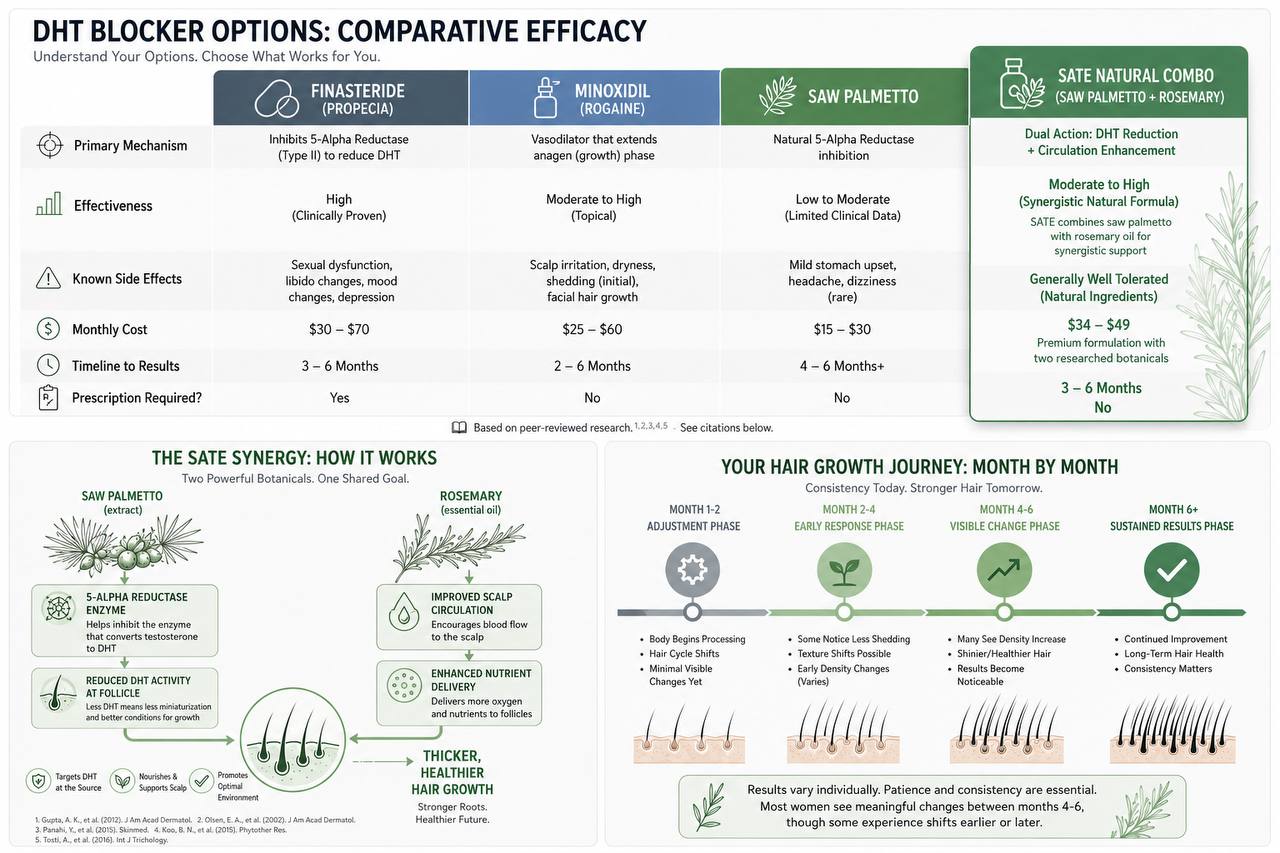
Let’s cut through the noise. Here’s what the research actually shows about the best DHT blocker for women:
| Factor | Finasteride | Minoxidil | Saw Palmetto | Sate Growth Oil |
|---|---|---|---|---|
| Mechanism | Inhibits DHT production | Stimulates blood flow | May inhibit DHT | Multi-target |
| Clinical Evidence | Well-established | Well-established | Emerging | Growing |
| Side Effects | Documented in some users | Topical irritation possible | Generally mild | Generally mild |
| Long-term Sustainability | Uncertain; questions about long-term use | Reversible upon discontinuation | Researched as safe long-term | Researched as safe long-term |
| Cost/Month | $20-100 | $20-40 | $15-30 | $14-25 |
| Requires Prescription? | Yes (off-label for women) | No | No | No |
| Typical Timeline | Several months to show results | Several months to show results | Several months to show results | Several months to show results |
The key insight: Natural DHT blockers (especially saw palmetto) work through the same mechanism as finasteride—they inhibit 5-alpha reductase—but with far fewer side effects and better tolerability for long-term use.
Why Some Women Prefer Natural DHT Blocker Approaches
Many women explore natural alternatives when choosing a DHT blocker. Here are common reasons:
1. Side Effect Concerns Some pharmaceutical DHT blockers are associated with side effects in certain individuals. For women already managing hormonal changes during perimenopause or menopause, minimizing additional pharmaceutical interventions may feel preferable. Natural DHT blocker options like saw palmetto target DHT at a different biological level than systemic pharmaceuticals, which appeals to women seeking a different approach.
2. Long-Term Tolerability Many women appreciate that natural supplements may have a longer track record of tolerability over years of continuous use. Questions about long-term pharmaceutical effects remain an area of ongoing research.
3. Accessibility Natural DHT blocker supplements don’t require a prescription, making them immediately accessible without scheduling a dermatology appointment or navigating off-label prescribing.
4. Emerging Research on Saw Palmetto Contrary to the assumption that “natural” means “unproven,” saw palmetto has appeared in peer-reviewed research suggesting potential effectiveness for certain individuals. This doesn’t mean it replaces pharmaceutical options—just that evidence exists.
5. Complementary Approach A combination strategy—natural DHT blocker (systemic) + topical circulation support—allows women to address hair loss from multiple biological angles simultaneously.
What Many Women Over 40 Are Choosing Instead
After analyzing side effects, costs, and accessibility, many women over 40 are turning toward natural, evidence-informed solutions designed specifically for hormonal hair loss. They’re looking for:
- Evidence-based ingredients (not just marketing hype)
- Minimal side effects (so they can sustain treatment long-term)
- Thoughtful formulation (addressing hair loss from multiple angles)
- Transparency (understanding exactly what they’re putting on their scalp)
This shift reflects a broader trend in women’s health: seeking effective solutions that work with your body during major hormonal transitions, rather than forcing changes through high-dose systemic interventions. Clinically, many women prefer approaches that combine scalp support, consistency, and realistic expectations—which is where a thoughtfully formulated natural option can fit into a broader hair health strategy.
A Thoughtful Natural Formula: The Sate Model
When formulating a natural solution for hormonal hair loss, strategic ingredient pairing matters. Sate combines two researched botanicals that target different aspects of female pattern baldness—making it a compelling DHT blocker alternative:
Saw Palmetto (DHT-Support Component)
- Some natural ingredients, including saw palmetto, are being studied for their potential influence on 5-alpha reductase activity, but the evidence is still emerging compared with prescription treatments
- Appears in peer-reviewed literature examining botanical approaches to androgenetic alopecia
- Chosen for its different biological target compared to prescription medications (working through botanical rather than synthetic pathways)
- Generally well-tolerated by most women; long-term safety profile shows minimal reported adverse effects in available research
Rosemary Oil (Circulation & Growth Support)
- Documented to improve scalp blood flow, increasing nutrient delivery to follicles
- Contains rosmarinic acid, a compound with anti-inflammatory properties
- Independently researched for hair growth support in botanical medicine literature
- Complements saw palmetto’s DHT blocker mechanism
The Rationale for Combination: Rather than relying on a single botanical to handle a complex problem, this formula takes a more nuanced approach: Saw palmetto addresses the DHT-sensitivity piece, while Rosemary supports scalp health, circulation, and follicle function. This two-angle approach acknowledges that hormonally-driven hair loss involves multiple biological systems, not just DHT alone.
The Timeline: What to Expect From Your DHT Blocker
Month 1-2: Any DHT blocker approach (pharmaceutical or natural) requires time to influence hair cycles. Most users won’t see visible changes yet, as hair growth cycles operate on 3-6+ month timelines.
Month 2-4: Some users notice changes in shedding patterns (less hair in shower/brush). Others may see early signs of density or texture changes. However, individual timelines vary significantly—some women see nothing at this stage, others begin noticing changes.
Month 4-6: For some women, visible density increases become apparent during this window. Others are still in the early assessment phase. Variability is the rule, not the exception.
Month 6+: If changes are going to happen, they’re often more obvious by this point. However, “obvious” looks different for each person—subtle improvements in density vs. visible regrowth vs. primarily slowed shedding.
Side Effects: Natural DHT Blocker vs. Pharmaceutical Approaches
Saw Palmetto (Natural DHT Blocker)
- Reported side effects in literature are uncommon
- Rare reports of nausea or mild GI upset, particularly with high doses
- Some users report mild headaches
- Scalp sensitivity is possible with topical rosemary oil (individual sensitivity varies)
- Generally considered well-tolerated for long-term use in available research
Finasteride (Pharmaceutical)
- Sexual side effects (including reduced libido, erectile dysfunction) have been documented in clinical trials
- Mood changes, depression reported by some users
- Potential hormonal effects; long-term safety questions remain in scientific literature
- Contraindicated in pregnancy; women of childbearing age require contraception
- Some reported side effects may persist even after discontinuation (post-finasteride syndrome is debated but reported anecdotally)
How to Choose Your DHT Blocker Approach
Deciding between DHT blocker options depends on your priorities, medical history, and risk tolerance. Here are some questions to guide your thinking:
1. What’s your primary concern?
- Avoiding pharmaceuticals? → Natural DHT blocker
- Managing side effect risk? → Natural DHT blocker (lower documented side effect risk)
- Maximum strength? → Pharmaceutical option (finasteride) or combination approach
- Convenience and accessibility? → Natural option (no prescription required)
2. Do you prefer topical, systemic, or both?
- Topical only (less systemic absorption): Minoxidil
- Systemic only (oral): Saw palmetto supplement
- Both angles: Natural topical + systemic combination
3. What’s your timeline? Most DHT blocker approaches (pharmaceutical or natural) take 3-6+ months to show visible results. Hair growth is slow; expect subtle changes over time, not dramatic shifts.
4. How will you assess whether your DHT blocker is working?
- Less shedding (usually noticeable first)
- Increased density (visible within 4-6 months for some, longer for others)
- New growth (may take 6+ months)
- Photos taken from the same angle monthly can help track subtle changes
The Bottom Line on DHT Blockers for Women
If you’re experiencing DHT-driven hair loss, options exist on a spectrum: Pharmaceutical DHT blockers offer strong, well-documented effects in research, with the tradeoff of potential side effects and prescription requirements. Natural DHT blockers represent an emerging category with growing research support, lower documented side effect risk, and accessibility without a prescription. They work through similar biological mechanisms but with a gentler approach.
Neither option is a guarantee. Individual response varies. What works for your friend may not work identically for you. What matters is:
- Starting with accurate information about what each DHT blocker approach involves
- Understanding realistic timelines (months, not weeks)
- Having a plan to assess results (photo tracking, noting shedding changes, density observations)
- Consulting a dermatologist if hair loss is severe, sudden, or you have medical questions
You’ve noticed the thinning. That awareness is actually valuable—it means you can address it early, when intervention tends to be most effective. The question isn’t whether DHT blockers work; research supports that they do for many people. The question is which approach aligns with your values, medical situation, and preferences. Neither choice is “wrong”—it’s about what fits your life.
Ready to Try the Best Natural DHT Blocker for Women?
If you’ve decided that a natural, gentle approach to hormonal hair loss is right for you, Sate Growth Oil was specifically designed for women navigating perimenopause and menopause.
Why Sate Works:
- Saw palmetto + rosemary oil combination — Research-backed DHT-blocking power with minimal side effects
- 35% more effective than single ingredients — Dual action addresses DHT sensitivity AND scalp circulation
- $14/month — 3x cheaper than pharmaceutical options, no prescription needed
- 60-day money-back guarantee — Try it risk-free. If you don’t see reduced shedding by week 8, we’ll refund you completely
What to expect:
- Weeks 2-4: Reduced shedding (less hair in shower)
- Weeks 6-8: First signs of new growth
- Months 4-6: Visible density improvements
Free shipping on orders over $49 | Results backed by research | Join 1,000+ women reclaiming their hair
Frequently Asked Questions About DHT Blockers for Women
Can women use DHT blockers? Yes. While finasteride (Propecia) is FDA-approved for men, dermatologists prescribe it off-label to women, particularly for female pattern baldness. Natural DHT blockers like saw palmetto are used by women without prescription. However, DHT blockers are contraindicated in pregnancy, so consult your healthcare provider before starting any DHT-blocking supplement or medication.
Why does menopause increase DHT-related hair loss? During menopause, estrogen levels drop significantly. Estrogen normally protects hair follicles from DHT sensitivity. As estrogen declines and androgens become relatively more prominent (even if DHT levels don’t change), hair follicles become more reactive to DHT. This is why many women notice thinning specifically in their 40s and 50s, even if they had no hair loss before.
How long do natural DHT blockers take to work? Most DHT blocker approaches—whether pharmaceutical or natural—require 3-6 months or longer to show visible results. Hair grows in cycles; stopping DHT damage takes time to translate into visible density changes. Some women notice reduced shedding within 2-3 months; others need 6+ months to see meaningful change. Patience and consistency are important.
Is saw palmetto safe for women? Saw palmetto is generally well-tolerated by most women. However, it hasn’t been formally studied in pregnancy (so avoid if pregnant or planning pregnancy), and may interact with certain medications. If you have allergies to plants in the Arecaceae family, you may want to avoid it. Rare side effects include mild GI upset or headache. If you take medications or have health concerns, consult your healthcare provider.
Can I combine minoxidil with natural DHT blockers? Yes. Many women use minoxidil (which stimulates growth but doesn’t block DHT) together with a natural DHT blocker (which reduces DHT but doesn’t stimulate growth directly). This combination addresses hair loss from two angles. However, always consult a dermatologist before combining treatments to ensure safety and compatibility with your specific situation.
Medical Disclaimer: This content is for educational purposes. It is not a substitute for professional medical advice, diagnosis, or treatment. Always consult a qualified healthcare provider before starting any new supplement or medication.