


Saw Palmetto for Women’s Hair Loss: Does It Really Work?
If you’ve noticed your hair thinning after 40, you’re not imagining it — and you’re not alone. Hormonal shifts during perimenopause and menopause cause noticeable hair loss in up to 50% of women by age 50. Saw palmetto has emerged as one of the most researched natural solutions for hormonal hair loss — but does it actually work for women?
Current evidence suggests saw palmetto may benefit women experiencing hormonal hair thinning, particularly where DHT sensitivity is a factor.
Research indicates saw palmetto may improve hair count and density in women with androgenetic hair loss — with several studies reporting meaningful improvements. Specifically, it works by targeting the root hormonal cause — not just masking symptoms.
Here’s exactly what the science shows, what real results look like, and whether saw palmetto is the right solution for your hair.
What Causes Hair Loss in Women Over 40?
Most women expect hot flashes and mood swings during perimenopause. What they don’t expect is losing their hair.
One primary mechanism drives hair loss during perimenopause and menopause: increased DHT sensitivity — one of the most common and least-discussed causes of female hair loss.
Here’s what happens:
1. Estrogen levels drop — Estrogen protects hair follicles. As it declines during perimenopause, that protection disappears.
2. Androgens become more active — With less estrogen, androgens (including testosterone) become relatively more dominant in your system.
3. DHT production increases — An enzyme called 5-alpha reductase converts testosterone into DHT (dihydrotestosterone).
4. DHT shrinks hair follicles — DHT binds to receptors in hair follicles, triggering miniaturization. Hairs grow thinner, shorter, and fall out faster than they regrow.
As a result, gradual but visible thinning occurs — typically at the crown, along the part line, and at the temples.
This is called female pattern hair loss (FPHL) or androgenetic alopecia. It’s the most common form of hair loss in women over 40, and it’s directly tied to hormones. See a full breakdown of why hair thins after 40 — including the hormonal cascade most doctors don’t explain.
The important thing to understand: Because it’s hormone-driven, it responds to hormone-targeted treatments — including saw palmetto.
How Does Saw Palmetto Work for Hair Loss?
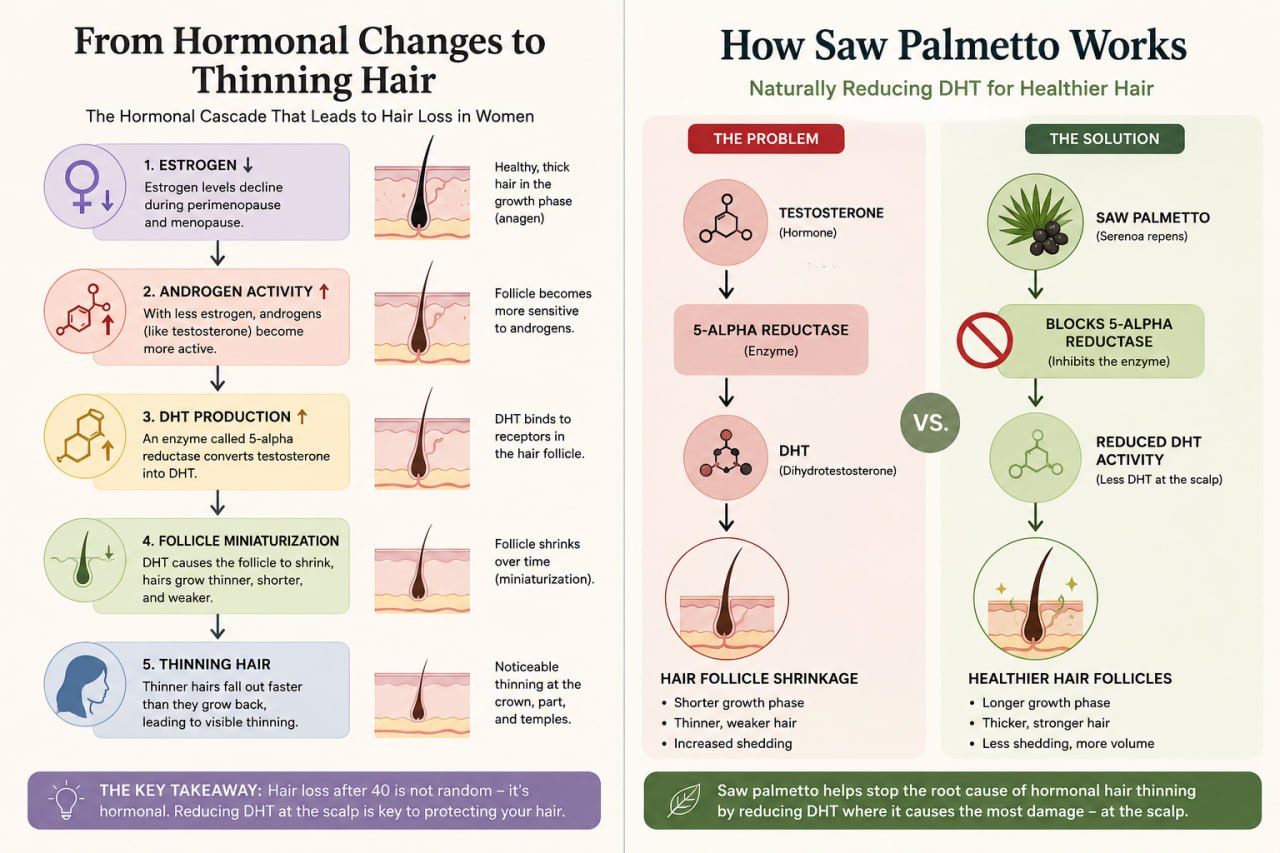
Saw palmetto (Serenoa repens) is a natural DHT blocker. It works by inhibiting 5-alpha reductase — the enzyme responsible for converting testosterone into DHT at the scalp.
The mechanism in plain terms:
Saw palmetto’s active compounds — including fatty acids and β-sitosterol — bind to the 5-alpha reductase enzyme and slow its activity. This reduces DHT production at the scalp level without disrupting your overall hormonal balance.
As a result, less DHT at the scalp means:
- Hair follicles stay larger and healthier
- Hairs spend more time in the growth (anagen) phase
- Hair grows back thicker and falls out less
Why this matters specifically for women in perimenopause:
Unlike pharmaceutical DHT blockers like finasteride (Propecia) — which creates systemic hormonal changes and is not FDA-approved for women — saw palmetto works locally at the scalp. It reduces DHT where it causes the most damage, without the systemic side effects associated with prescription hormone treatments.
For women who want a natural, evidence-backed approach to hormonal hair loss, saw palmetto is the most clinically supported option available.
What Does the Research Actually Show?
Research on saw palmetto is still growing — but the existing evidence is more promising than most people realize.
Key Research Findings:
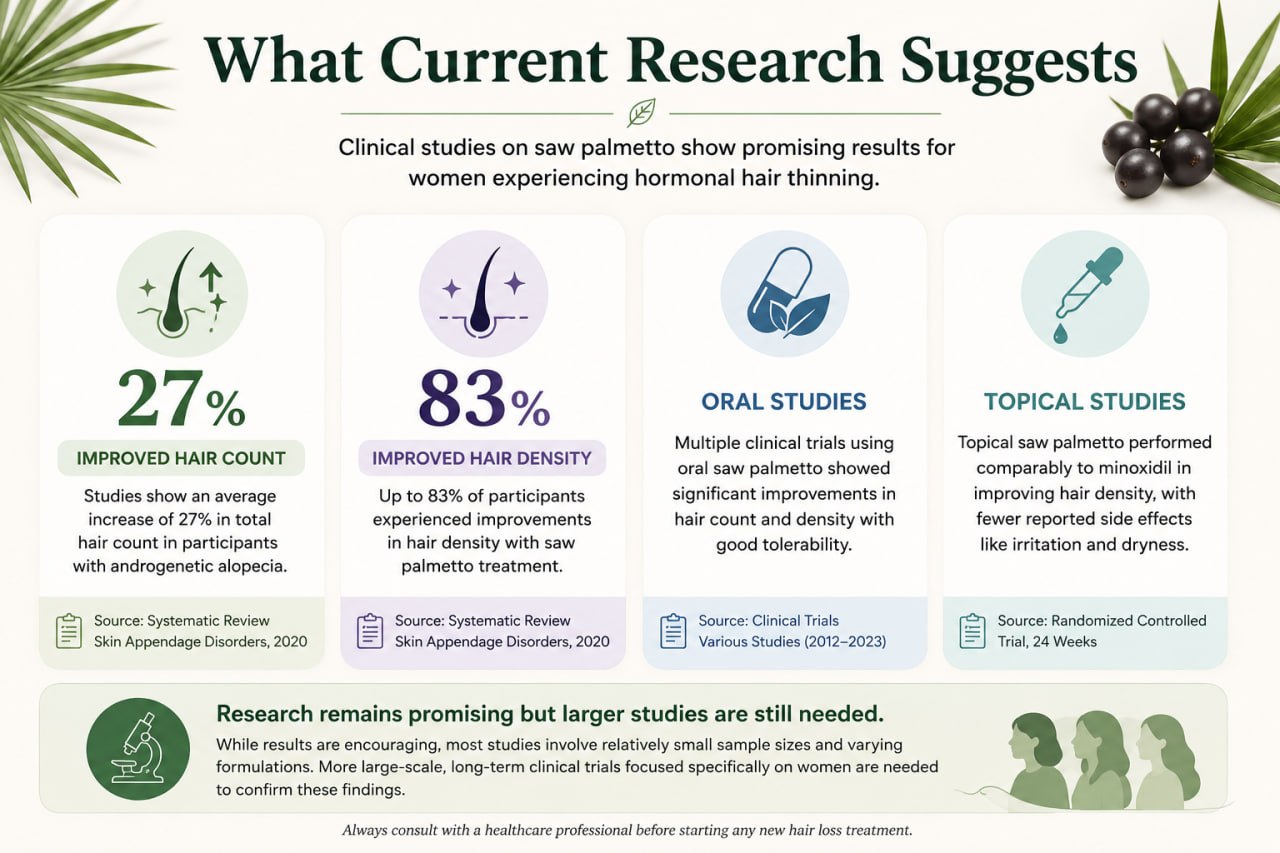
Systematic Review (Published in Skin Appendage Disorders, 2020)
A peer-reviewed systematic review analyzed multiple clinical trials on saw palmetto for hair loss and found:
- Reported improvement in total hair count by 27%
- Reported hair density improvement in 83% of participants with pattern hair loss
- Results observed in both men and women with androgenetic hair loss
- Topical application showed results comparable to oral supplementation in reviewed trials
Topical Saw Palmetto vs. Minoxidil (Randomized Controlled Trial)
A randomized controlled trial compared topical saw palmetto to 3% minoxidil in participants with androgenetic alopecia over 24 weeks:
- Both groups showed significant improvement in hair density and total hair count
- In comparison, minoxidil produced slightly higher total hair count at week 24
- The saw palmetto group reported significantly fewer side effects (scalp irritation, dryness, itching)
- Conclusion: Saw palmetto is a viable alternative for those who cannot tolerate minoxidil
Rosemary Oil Synergy Study
Research on rosemary oil — saw palmetto’s most effective complementary ingredient — found topical rosemary may improve hair count and performed comparably to 2% minoxidil in some studies. See the full rosemary vs. minoxidil comparison for a breakdown of the evidence. When rosemary’s circulation-boosting mechanism is combined with saw palmetto’s DHT-blocking action, the two may create a compound effect on scalp health.
Bottom line: No single study calls saw palmetto a definitive cure. But the cumulative clinical evidence consistently suggests it may improve hair density and total hair count in women with hormonal hair thinning — with a safety profile significantly better than pharmaceutical alternatives.
Research Limitations
While current findings are encouraging, most studies involve relatively small sample sizes, varying formulations, and mixed participant populations. Larger randomized controlled trials focused specifically on women are still needed before definitive conclusions can be made. As a result, women should view saw palmetto as a promising option rather than a proven cure.
Is Saw Palmetto Right for Your Type of Hair Loss?
Saw palmetto works by targeting DHT-driven follicle miniaturization. That means results depend significantly on what type of hair loss you have.
| Hair Loss Type | Evidence Level | Potential Benefit |
|---|---|---|
| Menopause-related thinning | Moderate | Strongest alignment |
| Female Pattern Hair Loss | Moderate | Likely |
| Androgenetic Alopecia | Moderate | Likely |
| Postpartum Shedding | Low | Limited |
| Thyroid-related Thinning | Low | Limited |
| Alopecia Areata | Very Low | Not DHT-driven |
If you’re in perimenopause or menopause and experiencing gradual thinning at the crown or part line, saw palmetto has the strongest evidence base for your specific situation. If your hair loss has a different root cause, it may be less effective — making it worth confirming the cause with a dermatologist or healthcare provider before investing time in any single treatment.
Not Sure What’s Causing Your Hair Loss?
Download our free:
Hormonal Hair Loss Survival Guide
Learn:
- Signs of hormonal hair loss
- DHT triggers
- Menopause hair strategies
- Natural treatment options
- How to choose the right solution for your hair type
Saw Palmetto Results: What Women Actually Experience
Understanding clinical research is one thing. Knowing what to expect in real life is another.
The Realistic Timeline
Months 1–2: Foundation Phase
- Reduced shedding is usually the first sign something is working
- Hair loss may slow before regrowth begins — this is normal and expected
- No visible regrowth yet
- The scalp environment is improving at the cellular level
Months 3–4: Early Regrowth Phase
- Many women notice shorter, finer “baby hairs” appearing — especially at the hairline and part
- Hair texture may feel slightly thicker
- Shedding is measurably reduced
Months 5–6: Visible Improvement Phase
- Hair density is noticeably improved
- The part line begins to look less wide
- Ponytail feels fuller
- Most clinical studies report significant measurable results at the 6-month mark
Months 6–12: Full Results Phase
- Optimal results are typically visible by month 9–12
- Follicles that were miniaturizing begin stabilizing and recovering
- Continued use maintains results — DHT reduction is an ongoing process
The #1 mistake women make: Stopping too early. Saw palmetto works by gradually reducing DHT at the scalp — it is not a fast fix. Women who stop at 6–8 weeks typically see no results and conclude it doesn’t work. Those who commit to 90+ days almost always see a meaningful difference.
Topical vs. Oral Saw Palmetto: Which Is More Effective for Hair?
Saw palmetto is available as oral supplements and topical products. For hair loss specifically, the delivery method matters significantly.
| Oral Saw Palmetto | Topical Saw Palmetto | |
|---|---|---|
| Absorption | Systemic (whole body) | Targeted (scalp only) |
| DHT targeting | Reduces DHT system-wide | Reduces DHT directly at hair follicles |
| Side effects | Possible GI discomfort, hormone interaction | Minimal — localized effect only |
| Speed to target site | Slower (digestion + circulation required) | Direct and immediate |
| Best for | Systemic androgen concerns | Hair-specific DHT reduction |
| Safety for women | Use with caution (check interactions) | Excellent — minimal systemic exposure |
For hair loss specifically, topical application wins. It delivers saw palmetto directly to the follicles — where DHT causes the most damage — without requiring systemic absorption.
This targeted delivery approach is why topical formulas produce results comparable to oral supplements in clinical trials, with significantly fewer side effects.
How to Use Saw Palmetto for Maximum Hair Results
How you use it matters just as much as what you use.
For Topical Application:
1. Apply directly to the scalp — not the hair shaft. You’re targeting the follicle, not the hair itself.
2. Use consistently, every day — consistent DHT suppression at the scalp is what drives results.
3. Massage in for 1–2 minutes — increases blood circulation and absorption into the scalp.
4. Pair with rosemary oil — rosemary independently improves scalp circulation and has its own DHT-inhibiting properties. The combination creates a dual-mechanism effect.
5. Give it a minimum of 90 days — before making any assessment of whether it’s working.
Common mistakes to avoid:
- Applying to unwashed scalp (reduces absorption)
- Skipping days and expecting the same results
- Stopping during the “purge phase” (temporary increase in shedding in weeks 3–6 is normal — it means the hair cycle is resetting)
- Using a formula with saw palmetto listed at the bottom of the ingredient list (concentration too low to be effective)
Is Saw Palmetto Safe for Women?
For most women, saw palmetto has an excellent safety profile — significantly better than pharmaceutical DHT blockers.
Generally considered safe for:
- Women experiencing hormonal hair thinning during perimenopause or menopause
- Long-term topical use
- Combination with hair-supporting supplements like biotin and iron
Important cautions:
- Pregnancy and breastfeeding: Saw palmetto is not recommended — it affects hormone metabolism
- Blood thinners: May interact with warfarin or high-dose aspirin — consult your doctor before use
- Hormonal medications: If you’re on HRT, estrogen therapy, or hormonal contraceptives, discuss with your healthcare provider first
In contrast, topical saw palmetto carries significantly fewer safety concerns than oral supplements because absorption is localized — far less systemic exposure compared to swallowing a capsule.
Why the Rosemary + Saw Palmetto Combination Outperforms Either Alone
On its own, saw palmetto is effective. Paired with rosemary oil, the combination amplifies results through two separate biological pathways.
Saw Palmetto: Inhibits 5-alpha reductase → reduces DHT production at the follicle level
Rosemary Oil: Stimulates blood circulation to the scalp → activates dormant follicles + independently inhibits DHT
Together, they create a two-pathway approach:
1. DHT is blocked from forming (saw palmetto)
2. Existing follicles are stimulated, nourished, and activated (rosemary)
This two-pathway approach is the basis of Sate’s Rosemary + Saw Palmetto Growth Oil — a topical formula that combines both ingredients, designed for women experiencing age-related and hormone-related thinning.
Frequently Asked Questions
How long does saw palmetto take to work for women’s hair loss?
Most women notice reduced shedding within 4–8 weeks. Visible hair regrowth typically begins at months 3–4, with optimal results at 6–12 months of consistent use.
Does saw palmetto really block DHT in women?
Yes. Saw palmetto inhibits 5-alpha reductase — the enzyme that converts testosterone into DHT. Indeed, clinical research confirms this mechanism works in both men and women with hormonal hair thinning.
Can saw palmetto regrow hair that’s already been lost?
It depends on how long follicles have been dormant. Saw palmetto is most effective at stopping further loss and improving the density of existing hair. Follicles that have been severely miniaturized for many years may not fully recover.
Is topical or oral saw palmetto better for hair loss?
When targeting hair loss specifically, topical application delivers saw palmetto directly to hair follicles — making it more targeted and producing fewer side effects than oral supplementation.
Safety, Dosage & Side Effects
What is the right saw palmetto dosage for women’s hair loss?
For oral supplements, clinical studies typically use 320mg per day of standardized extract. For topical products, concentration varies — look for products listing saw palmetto extract in the top half of the ingredient list.
Is saw palmetto safe to use long-term?
In most cases, yes. Topical saw palmetto has a strong long-term safety profile. Oral supplements are generally safe but should be discussed with a healthcare provider if you take hormonal medications.
Does saw palmetto affect hormones in women?
Topical saw palmetto minimizes systemic hormonal effects because absorption is localized. Oral saw palmetto may have mild systemic anti-androgen effects — which is why it is not recommended during pregnancy.
Can I use saw palmetto with minoxidil?
There is no known dangerous interaction. Some women combine them. If you choose to combine, start one product at a time so you can accurately assess individual results.
Why is my hair shedding more after I started saw palmetto?
This is called the “purge phase” — a temporary increase in shedding that can occur as the hair growth cycle resets. It typically resolves within 4–6 weeks. If shedding is severe or prolonged beyond 6 weeks, consult a dermatologist.
Is saw palmetto the same as finasteride for women?
No. Both inhibit 5-alpha reductase, but finasteride is a pharmaceutical with stronger systemic effects and is not FDA-approved for women. Saw palmetto is a natural alternative with a far gentler, better-tolerated safety profile.
Does saw palmetto work for all types of women’s hair loss?
Saw palmetto is most effective for androgenetic alopecia (female pattern hair loss driven by DHT sensitivity). It is less likely to help with alopecia areata (autoimmune hair loss) or traction alopecia (caused by physical damage to follicles).
What should I look for in a saw palmetto product for women’s hair loss?
Look for: topical delivery (direct scalp absorption), standardized saw palmetto extract listed high in the ingredients, complementary ingredients like rosemary oil, a clean formula without harsh sulfates or synthetic hormones, and transparent ingredient sourcing.
The Bottom Line: Does Saw Palmetto Work for Women’s Hair Loss?
Current evidence suggests yes — with realistic expectations.
Saw palmetto is one of the most clinically supported natural solutions for hormonal hair loss in women. It works by targeting the root cause — DHT at the scalp — not just masking symptoms.
Studies indicate:
- Reported improvement in total hair count by up to 27% in reviewed trials
- Hair density improvement observed in up to 83% of participants
- Meaningful results at 6 months with consistent use
- A safety profile significantly better than pharmaceutical alternatives
However, it won’t reverse years of hair loss overnight. But for women in perimenopause or menopause experiencing DHT-driven thinning, it is one of the most evidence-backed natural tools available.
Sate’s Rosemary + Saw Palmetto Growth Oil combines rosemary oil and saw palmetto in a topical formula designed for women experiencing age-related and hormone-related thinning. It focuses on the two mechanisms the evidence supports most: DHT inhibition and scalp circulation.
→ Try Sate Risk-Free. 60-Day Guarantee.
Related reading:
- Best DHT Blocker for Women’s Hair Loss: Natural vs. Pharmaceutical
- Rosemary Oil vs. Minoxidil: What the Research Actually Shows
- Why Hair Thins After 40: Hormones, Menopause & What to Do