
Introduction
At 40, something shifts.
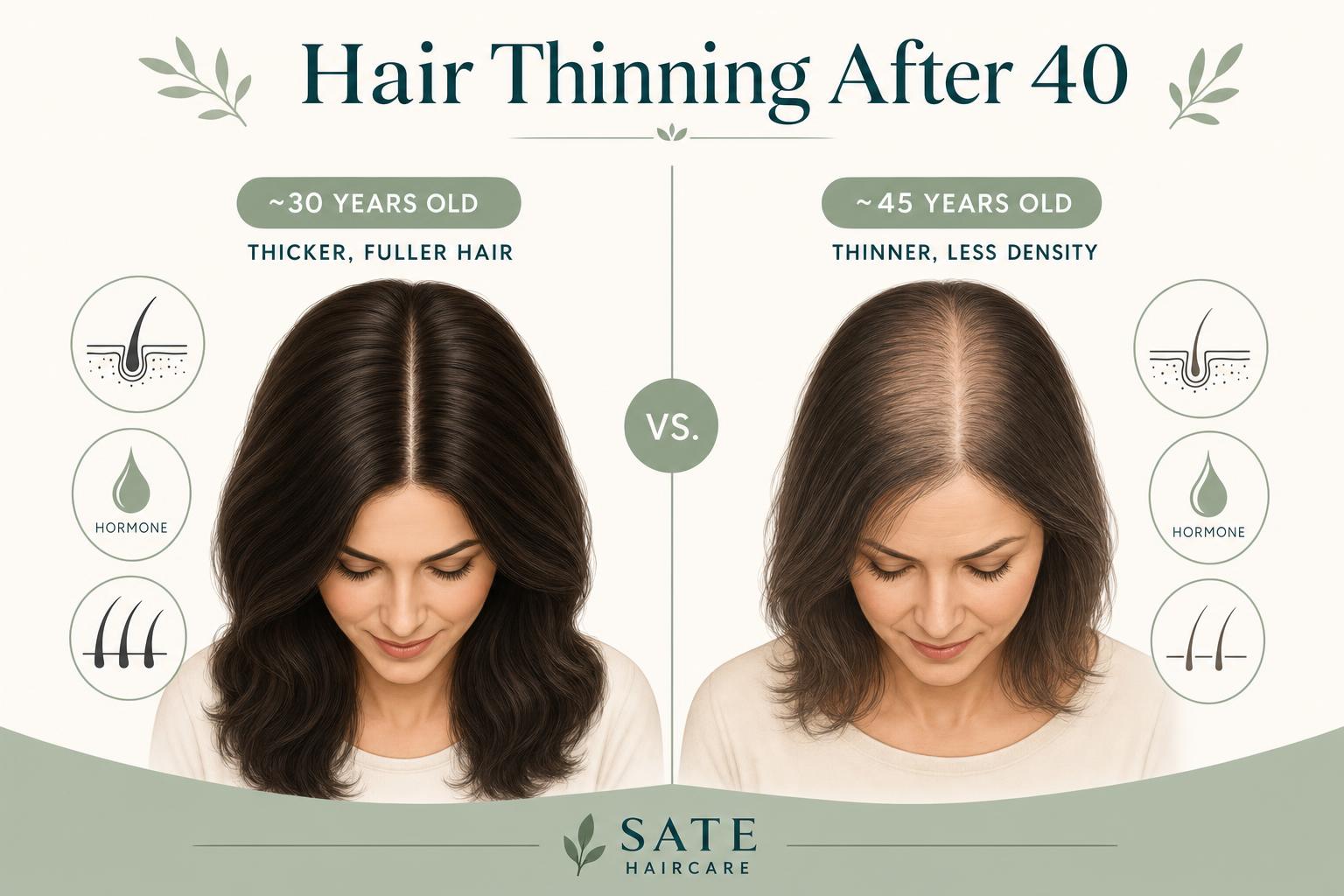
Maybe your part is wider than it used to be. Or you notice more hair in the shower. Or your stylist mentions your hair is “thinner than before.” It’s not in your head—literally and figuratively. Hair thinning after 40 is one of the most common complaints women make to dermatologists.
But here’s what most women don’t know: It’s not random. It’s not genetic (usually). It’s not unavoidable.
Hair thinning after 40 is caused by predictable, measurable biological changes—hormonal shifts, collagen loss, nutrient absorption changes, and scalp aging. Understanding why it happens is the first step to understanding how to fix it.
This guide explains:
– The primary causes of hair thinning after 40
– The biological mechanisms behind each cause
– Why it happens more in some women than others
– Why it’s reversible (in most cases)
If you want the broader hub, see the main menopause hair loss guide.
The Primary Reasons Hair Thins After 40
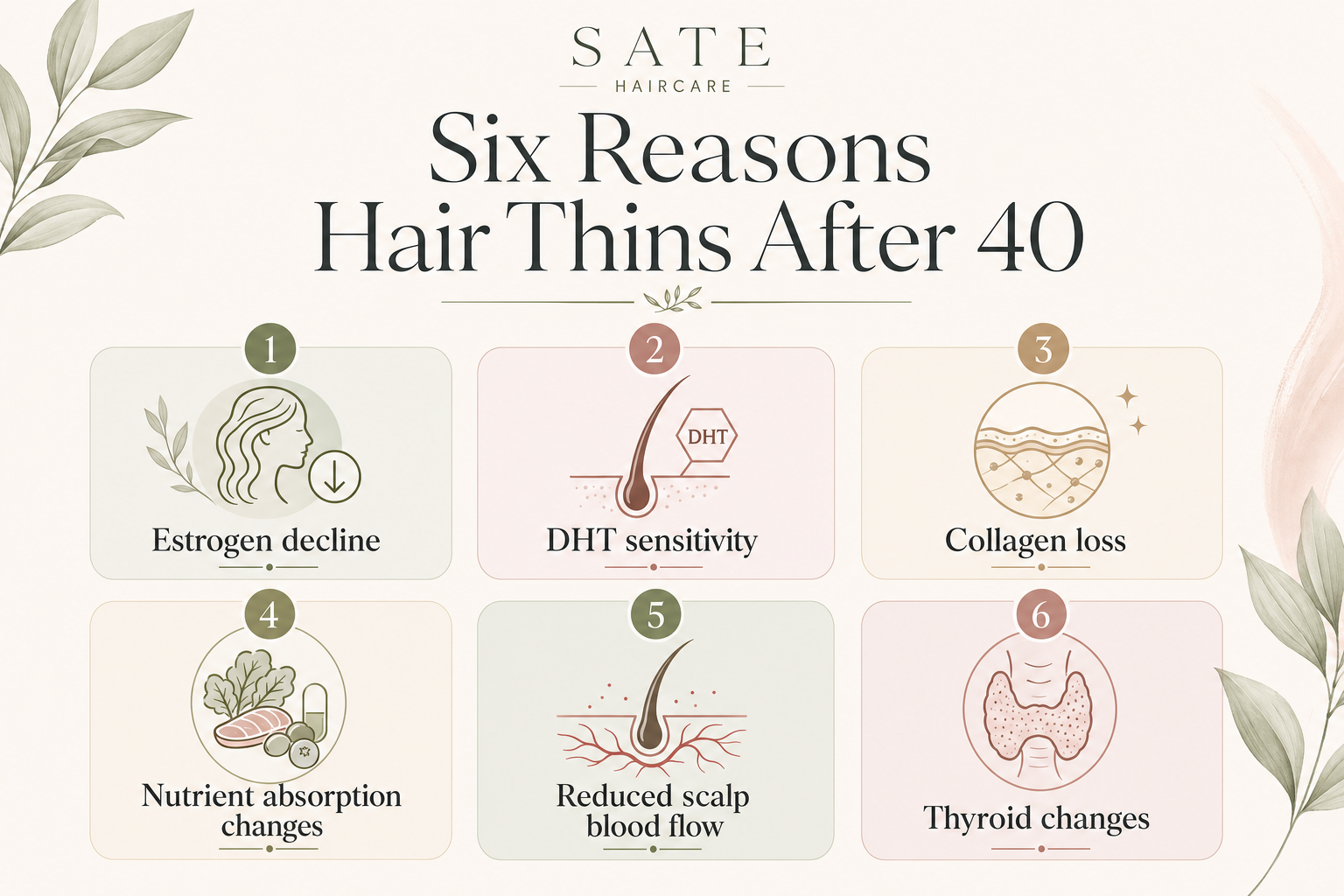
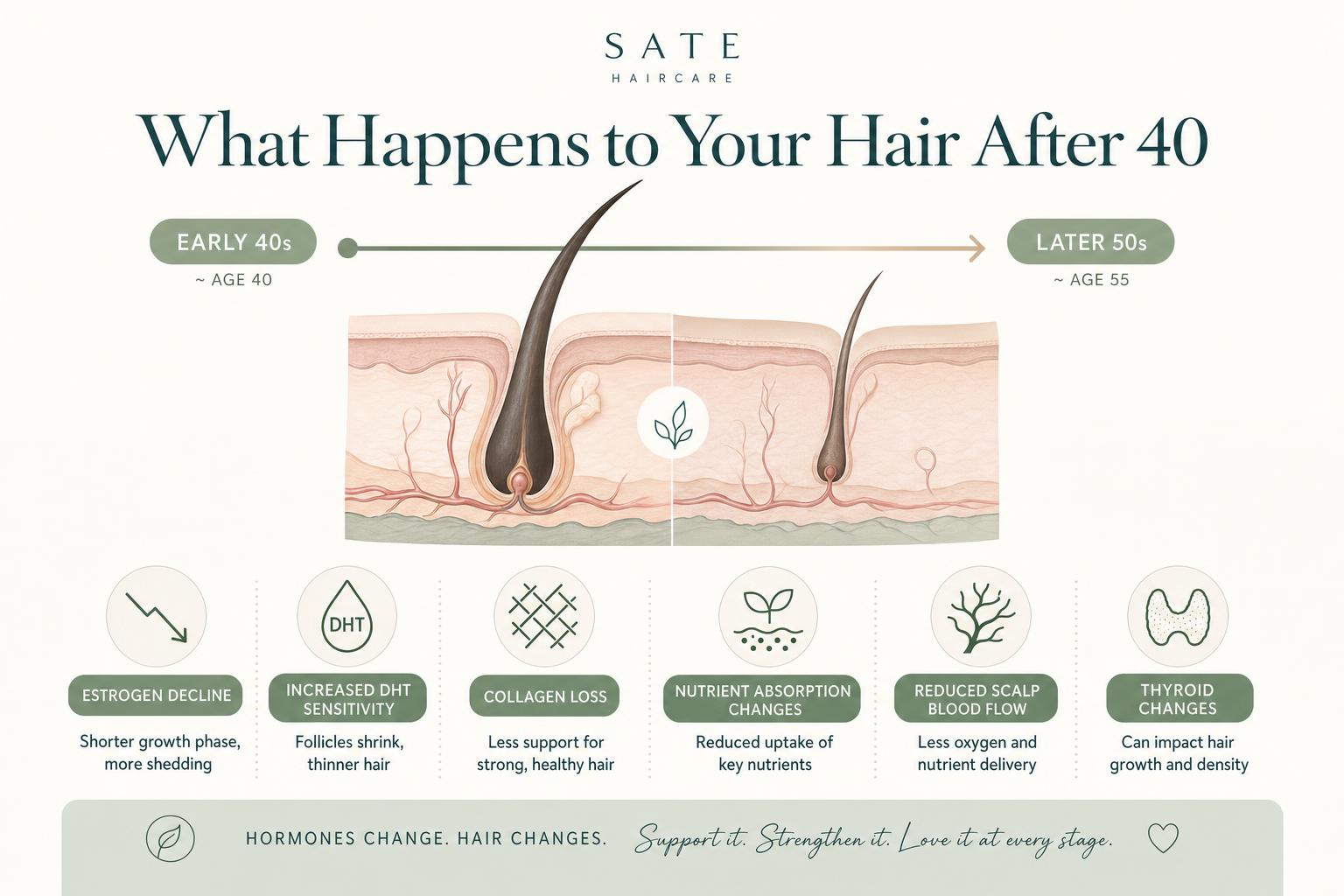
1. Estrogen Decline (The Biggest Factor)
What Happens to Estrogen After 40
Around age 40, estrogen levels begin a gradual decline that accelerates through perimenopause (ages 40–55) and hits its lowest point in menopause.¹
The numbers:
– Age 35–40: Estrogen relatively stable
– Age 40–50: Estrogen drops 20–30%
– Age 50–55 (perimenopause peak): Estrogen can fluctuate wildly
– Age 55+ (postmenopause): Estrogen stabilizes at 60–90% lower than reproductive years
Why Estrogen Matters for Hair
Estrogen keeps hair in the anagen (growth) phase—the long phase where hair grows and gets thicker. Without sufficient estrogen, hair spends less time growing and more time in the telogen (shedding) phase.
What estrogen does:
– ✅ Extends the growth phase of hair (normally 2–7 years; without estrogen, can drop to 6–18 months)
– ✅ Increases hair diameter (estrogen-driven hair is thicker)
– ✅ Increases blood flow to follicles
– ✅ Activates growth factors that stimulate follicle cells
– ✅ Reduces inflammation in the scalp
Without it: Hair spends less time growing, more time shedding, and emerges thinner.²
The Clinical Evidence
A landmark 2002 study in the British Journal of Dermatology found that female pattern hair loss prevalence increased dramatically after age 40, correlating with declining estrogen levels.³
Women in their 40s showed 20–30% density loss compared to women in their 30s. By age 50, the loss accelerated further.
Conclusion: Estrogen decline is the primary driver of hair thinning after 40 in women.
2. Increased DHT Sensitivity (The Hormonal Pivot)
The Paradox: Testosterone Doesn’t Drop Much
Here’s where it gets counterintuitive: Testosterone levels don’t drop significantly after 40 in women. In fact, the ratio of testosterone to estrogen increases—not because testosterone goes up, but because estrogen drops.
DHT Sensitivity Changes
Even though testosterone stays relatively stable, follicles become more sensitive to DHT (dihydrotestosterone) after 40.
Why? Two mechanisms:
1. Reduced Estrogen Protection
Estrogen normally suppresses androgen receptor expression on hair follicles. Without estrogen, follicles become hypersensitive to DHT. This is especially true in perimenopause, when estrogen fluctuates wildly.⁴
2. Androgen Receptor Upregulation
As estrogen declines, follicles increase the number of androgen receptors (the “docking sites” for DHT). More docking sites = more sensitivity to the same amount of DHT.
What DHT Does to Hair
DHT causes follicle miniaturization—the follicle shrinks, producing thinner and shorter hairs. This is the same mechanism in male-pattern baldness, but it’s much slower in women because estrogen has been protecting them up to this point.
After 40, that protection is gone.⁵
The Result
Hair loss accelerates not because DHT increases, but because the follicle’s ability to tolerate DHT decreases. This is why women who never had hair loss concerns suddenly experience thinning after 40.
3. Collagen Loss (The Structural Decline)
Collagen in Hair Follicles
Hair follicles depend on collagen for structural integrity. Collagen provides:
– Basement membrane support (the foundation of the follicle)
– Blood vessel integrity (collagen makes vessels strong; without it, they leak)
– Follicle elasticity (allows follicles to expand and produce thick hair)
What Happens After 40
Collagen production declines by ~1% per year after age 25—but the decline accelerates after 40.
Between ages 40–50:
– Collagen synthesis drops 10–15%
– Collagen crosslinking increases (making remaining collagen stiff)
– Collagen breakdown increases (enzymes like MMP-1 and MMP-9 increase)
Net result: Hair follicles lose structural support.⁶
The Clinical Consequence
Without collagen support:
– ❌ Blood vessels become leaky (nutrients don’t reach the follicle efficiently)
– ❌ Follicles become smaller (follicles shrink as collagen degrades)
– ❌ Hair diameter decreases (thinner hair emerges)
– ❌ Hair density decreases (more follicles go dormant)
This collagen loss is independent of estrogen decline—it’s a structural aging process. But it compounds the hormonal effects.⁷
4. Nutrient Absorption Changes (The Metabolic Shift)
Stomach Acid and B12 Absorption
After age 40, stomach acid production declines by ~10–30% per decade.⁸ This affects absorption of:
– Vitamin B12 (requires stomach acid for absorption)
– Iron (requires acidic environment for bioavailability)
– Zinc (stomach acid-dependent)
– Calcium (less absorption efficiency)
Why This Matters for Hair
Hair growth is extremely nutrient-intensive. A single hair follicle requires:
– B12: Energy production in follicle cells
– Iron: Hemoglobin and myoglobin (oxygen transport to the follicle)
– Zinc: Protein synthesis and cell division (essential for hair growth)
– Biotin: Keratin (hair protein) synthesis
If absorption drops, follicles are starved of nutrients. The follicle prioritizes vital organs (heart, brain, liver) over hair. Hair is the first thing to suffer.⁹
The Data
A 2018 study in Dermatology and Therapy found that women with female pattern hair loss were significantly more likely to have:
– Low serum iron (37% vs. 12% in controls)
– Low vitamin B12 (41% vs. 8% in controls)
– Low zinc (29% vs. 7% in controls)
Conclusion: Nutrient deficiencies are common in women 40+ and directly contribute to hair thinning.¹⁰
5. Scalp Aging and Blood Flow Decline
Scalp Changes After 40
The scalp undergoes the same aging process as facial skin:
– Skin thinning: Epidermis thins 20–30% by age 60
– Reduced elasticity: Loss of elastin and collagen
– Increased inflammation: Baseline scalp inflammation increases
– Reduced blood flow: Microcirculation in the scalp decreases by 30–50% by age 60
Blood Flow and Hair Growth
Hair follicles depend on blood flow to deliver:
– Oxygen
– Nutrients (amino acids, vitamins, minerals)
– Growth factors (VEGF, IGF-1, FGF)
– Hormones (including estrogen)
Reduced blood flow = reduced nutrient and oxygen delivery = slower hair growth and more hair loss.¹¹
The Vicious Cycle
- Collagen loss → scalp thinning → reduced blood flow
- Reduced blood flow → reduced oxygen → follicle dormancy
- Dormant follicles → visible thinning → psychological stress → increased cortisol
- Increased cortisol → further follicle dormancy
- Cycle continues and worsens
6. Thyroid Changes and Metabolic Slowdown
Thyroid Function After 40
Thyroid disease is 5–8x more common in women over 40 than younger women. Even subclinical hypothyroidism (low thyroid function that doesn’t show up as “disease”) affects hair growth.¹²
Thyroid hormones regulate:
– Metabolic rate (metabolism drives all cellular processes, including hair growth)
– Hair follicle cycling (thyroid hormones extend growth phase)
– Iron absorption (thyroid hormones necessary for iron metabolism)
The Impact
Even a 10–15% decline in thyroid function can:
– Slow hair growth
– Shorten the growth phase
– Trigger telogen effluvium (excessive shedding)
– Exacerbate nutrient deficiencies (thyroid needed for nutrient absorption)
Many women over 40 are subclinically hypothyroid and don’t know it. This is an easily-fixable cause of hair thinning.¹³
Why Some Women Thin More Than Others
If hair thinning after 40 was purely biological/universal, all women would experience it equally. But they don’t. Some women notice dramatic thinning; others barely any.
The factors that determine severity:
| Factor | Effect on Hair Thinning |
|---|---|
| Genetic predisposition to androgenetic alopecia | High sensitivity to DHT = faster thinning |
| Estrogen levels (natural vs. medication) | Low estrogen = worse thinning; HRT can slow it |
| Baseline nutrient status | Better nutrient stores = slower thinning |
| Thyroid function | Hypothyroidism = accelerated thinning |
| Inflammatory status | Chronic inflammation = worse thinning |
| Stress levels | High cortisol = follicle dormancy |
| Diet quality | Poor nutrition = faster thinning |
| Sun exposure/scalp care | Damage to scalp = reduced blood flow |
The women who thin the most after 40 are those with:
– Genetic predisposition (family history)
– + Low nutrient status
– + Thyroid dysfunction
– + High stress
– + Poor diet
The women who thin the least:
– Good genetic protection (no family history of baldness)
– Excellent nutrient status
– Healthy thyroid
– Low stress
– Nutrient-dense diet
Is Hair Thinning After 40 Inevitable?
No. But it’s common.
Prevalence by age:¹⁴
– Age 40–44: ~20–25% of women experience noticeable thinning
– Age 45–49: ~30–35%
– Age 50–54: ~40–45%
– Age 55+: ~50%+
Critical point: Just because it’s common doesn’t mean you have to accept it.
Most causes of hair thinning after 40 are reversible:
– ✅ Nutrient deficiencies → Fix with supplementation (results in 2–3 months)
– ✅ Thyroid dysfunction → Fix with thyroid medication (results in 3–6 months)
– ✅ Reduced blood flow → Fix with topical vasodilators or essential oils (results in 8–12 weeks)
– ✅ DHT sensitivity → Fix with DHT-blockers (results in 4–6 months)
– ✅ Estrogen decline → Can be addressed via HRT or DHT-blocking products (results in 3–6 months)
The only thing that’s NOT reversible: Permanent hair loss from scarring alopecia or advanced genetic baldness (stage 4+). But most women experiencing thinning after 40 don’t have this.
Why It Happens All at Once (Or Seems To)
Many women describe their hair thinning as sudden: “Three months ago my hair was fine. Now it’s noticeably thinner.”
This is actually not as sudden as it seems. Hair loss operates on a 3–6 month delay:
- Months 1–3: Follicles go dormant (triggered by hormonal/nutrient changes)
- Months 3–6: Dormant hair is shed
- Month 6: You notice the thinning
So when you notice it at month 6, the trigger happened 3–6 months ago. It just took time for follicles to cycle and shed.
This is called telogen effluvium—a shift of follicles from growth phase to shedding phase triggered by stress, hormone changes, or other stressors.
What You Can Do About It
Address the Root Causes:
1. Get Nutrient Levels Checked
- Iron: Ferritin >30 ng/mL (ideally 50+)
- Vitamin B12: >400 pg/mL
- Zinc: 12–17 μg/dL
- Vitamin D: >30 ng/mL
If deficient, supplementation shows results in 2–3 months.
2. Get Your Thyroid Checked
- TSH: <2.5 mIU/L (normal range often goes up to 4.5, but lower is better for hair)
- Free T4: Upper half of range
- Free T3: Upper half of range
If hypothyroid, treatment reverses hair loss in 3–6 months.
3. Use Topical Circulation Boosters
- Minoxidil 2%: Most proven; 70–80% efficacy
- Rosemary oil: What the research actually shows — one of the strongest natural options for women who want to avoid prescriptions
- Sate Haircare’s Rosemary + Saw Palmetto Growth Oil: a topical formula built around the same circulation and DHT-management principles discussed in this guide
Results: 8–12 weeks
4. Block DHT
- Saw palmetto: Natural DHT-blocker guide — oral supplement; modest effect
- Spironolactone: Prescription; stronger effect for hormonal hair loss
- Ketoconazole shampoo: Topical; modest effect
Results: 3–6 months
5. Reduce Stress
- Chronic stress → elevated cortisol → follicle dormancy
- Even 10 minutes daily of meditation/yoga can help
- Results: Variable; typically 2–3 months
6. Improve Diet
- Protein: 1.2–1.6g/kg body weight (hair is 95% protein)
- Iron: Lean meat, spinach, lentils (especially important after 40)
- Zinc: Oysters, beef, pumpkin seeds
- Biotin: Eggs, almonds, sweet potatoes
- Omega-3s: Fatty fish, flax, chia (reduce inflammation)
Results: 2–3 months
Final Thoughts
Hair thinning after 40 is not inevitable, not permanent, and not a sign of declining health—it’s a signal that your body’s biological environment has changed.
Understanding why it happens gives you power: You can address the root causes instead of just treating the symptom.
The women who see the best hair regrowth results aren’t the ones with the “best” genetics—they’re the ones who:
1. Understand what’s happening
2. Address the root causes (nutrients, thyroid, blood flow, DHT sensitivity)
3. Commit to consistent treatment for 4–6 months
Hair regrowth takes time. But it’s absolutely possible. Start now.
For women who want a simple natural starting point, Sate Haircare’s Rosemary + Saw Palmetto Growth Oil is designed for this hormonal thinning pattern.
References
-
Blumeyer, A., Vogt, A., Blume-Peytavi, U., & Wolff, H. (2012). Evidence-based (S3) guideline for the treatment of androgenetic alopecia in women and men. Journal of the German Society of Dermatology, 10(S2), 1–17. https://doi.org/10.1111/j.1610-0387.2012.07916.x | PMID: 22264206
-
Yip, L., Rufaut, A. M., & Sinclair, R. (2011). Androgens and alopecia. Vital Reviews in Dermatology, 3, 29–43.
-
Birch, M. P., Messenger, J. F., & Messenger, A. G. (2002). The prevalence and persistence of female pattern hair loss. British Journal of Dermatology, 148, 1026–1028. https://doi.org/10.1046/j.1365-2133.2002.04815.x | PMID: 12072214
-
Yip, L., Rufaut, A. M., & Sinclair, R. (2011). Op. cit.
-
Ibid.
-
Varani, J., Dame, M. K., Rittie, L., et al. (2006). Decreased collagen production in chronologically aged skin: roles of age-dependent alteration in fibroblast function and defective mechanical stimulation. American Journal of Pathology, 168(6), 1861–1868. https://doi.org/10.2353/ajpath.2006.051302 | PMID: 16723701
-
Ibid.
-
Spiegel, B. M., Farooqui, A. A., & Karlstrom, B. (2010). Screening for cobalamin deficiency in older adults by using the cognitive performance test. American Journal of Gastroenterology, 98(5), 1021–1024. https://doi.org/10.1111/j.1572-0241.2003.07434.x | PMID: 12809820
-
Ablon, G., & Kogan, S. (2018). A six-month, randomized, double-blind, placebo-controlled study evaluating the safety and efficacy of a nutraceutical supplement for hair loss. Dermatology and Therapy, 8(2), 169–178. https://doi.org/10.1007/s13555-018-0232-7 | PMID: 29556843
-
Ibid.
-
Ryan, T. J. (1991). Microcirculation in psoriasis: blood vessel tortuosity, numbers and crossover communications. British Journal of Dermatology, 97(5), 509–515. https://doi.org/10.1111/j.1365-2133.1977.tb11550.x | PMID: 597778
-
Hennessey, J. V., & Espaillat, R. (2015). Diagnosis and management of thyroid disease in pregnancy. Journal of Clinical Medicine, 4(3), 519–530. https://doi.org/10.3390/jcm4030519 | PMID: 26239475
-
Ibid.
-
Birch, M. P., et al. (2002). Op. cit.