
Menopause Hair Loss: What’s Actually Happening — and What You Can Do About It
You’re not imagining it. Menopause hair loss is real, common, and tied to the hormonal shift happening in your 40s and 50s.
The hair in your shower drain, the widening part line, and the thinner ponytail are signs of biology, not vanity. The good news is that there are evidence-backed ways to slow shedding and support regrowth, including natural approaches that do not require a prescription.
This guide breaks down the science behind menopausal hair thinning, the natural options with the strongest support, realistic timelines, and how to build a regimen that fits your routine.
Why Menopause Causes Hair Loss
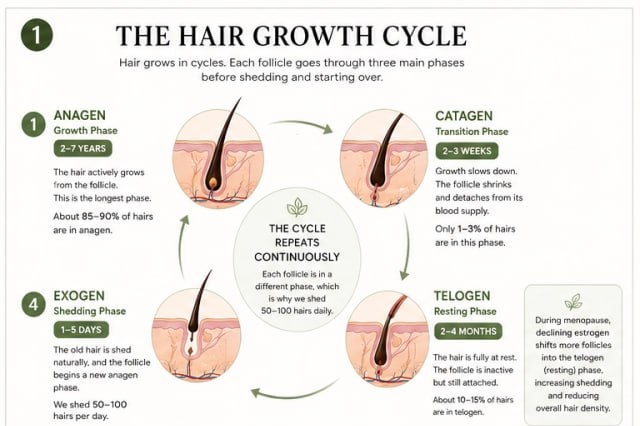
Hair loss during menopause is primarily hormonal. Understanding why helps you choose the right approach.
The Estrogen-Progesterone Drop
During your reproductive years, estrogen and progesterone play a protective role for hair follicles. Estrogen prolongs the hair’s growth phase (anagen), keeping follicles in active production longer. Progesterone helps balance androgens — the male-type hormones that, in excess, can cause follicle miniaturization.
As you enter perimenopause and menopause, both hormones decline significantly. Research consistently shows that declining estrogen levels are directly associated with changes in hair follicle cycling, including shortened growth phases and increased shedding — a relationship documented across multiple studies in dermatology and reproductive endocrinology literature.
What this means: When estrogen and progesterone drop, hair spends less time growing and more time in the shedding phase. Estrogen-related hair loss during menopause is a direct result of this shift — which is why so many women experience increased hair shedding during menopause after 40. Hormonal hair thinning in women is one of the most under-discussed consequences of the estrogen decline that defines this life stage.
The DHT Problem
At the same time estrogen falls, androgens — particularly dihydrotestosterone (DHT) — become relatively more dominant. DHT-related hair loss in women during menopause is driven by this hormonal imbalance. In women genetically sensitive to DHT, this shift triggers follicle miniaturization: a process where individual hair follicles progressively shrink, producing thinner, shorter strands until they stop producing hair entirely.
This pattern — diffuse thinning across the crown and top of the scalp, with the hairline often preserved — is known as female pattern hair loss (androgenetic alopecia). Research suggests approximately 25% of women develop clinically detectable female pattern hair loss by age 49, rising to roughly 40% by their late 60s and over 50% by age 79 (Sinclair et al., PMC).
Bottom line: The menopausal transition creates the hormonal conditions for thinning hair, especially in women sensitive to DHT. That is why this guide focuses on both the cause and the support options.
For a deeper look at DHT and how to manage it naturally, see our guide: Best DHT Blocker for Women’s Hair Loss: Natural vs. Pharmaceutical
Telogen Effluvium: The Shedding Surge
Some women experience a sudden surge in hair shedding during menopause — finding hair everywhere, on pillows, in the drain, on clothing. This is often telogen effluvium: a temporary but alarming condition where a large percentage of follicles simultaneously enter the resting/shedding phase, often triggered by hormonal shifts, stress, or nutritional changes.
Unlike androgenetic alopecia, telogen effluvium is typically reversible once the trigger is addressed. But if left unmanaged, it can layer on top of hormonal thinning and make the situation significantly worse.
Is It Really Menopause? How to Tell
Not all hair loss in your 40s and 50s is menopausal. Here’s how to differentiate:
Signs It’s Hormonal Hair Loss
If you’re asking yourself “why is my hair falling out during menopause?” or “why is my hair thinning so fast?” — these are the patterns to look for:
- Diffuse thinning across the crown and top of the scalp — not patchy or in specific areas
- Gradual progression over months or years, not sudden overnight loss
- Noticeable at the part line — the part appears wider, scalp more visible
- Smaller ponytail circumference — same routine, noticeably thinner ponytail
- Increased shedding — more hair in the drain, on your brush, on your pillow
- Timeline alignment — symptoms began during perimenopause or menopause transition
Signs It Might Be Something Else
Thyroid disorders, iron deficiency anemia, autoimmune conditions, and certain medications can all cause hair loss that mimics hormonal patterns. If your hair loss is:
- Patchy or in distinct circular areas
- Accompanied by fatigue, weight changes, or skin changes
- Very sudden and severe
- Not responding to any intervention
…a visit to your doctor for bloodwork is the right first step before starting any regimen.
Perimenopause vs. Menopause: Does the Timing Matter?
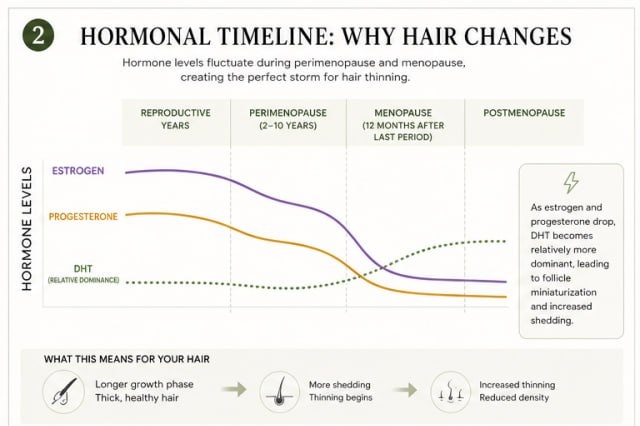
Yes — and here’s why.
Perimenopause is the transition phase — typically beginning in the mid-40s — when hormone levels begin fluctuating unpredictably. Hair loss can actually be worse during perimenopause than during menopause itself, because fluctuating estrogen creates a more chaotic hormonal environment than steadily low estrogen does.
Menopause (defined as 12 consecutive months without a period) typically brings more stable — though lower — hormone levels. Perimenopause hair thinning often presents more erratically due to fluctuating hormones, while post-menopause hair loss tends to be more gradual and predictable.
Understanding which phase you’re in helps calibrate expectations. Women in early perimenopause who start a natural hair support regimen often see better outcomes than those who wait until post-menopause.
→ For a deep dive on perimenopause-specific hair loss patterns: Perimenopause Hair Loss Causes: What’s Actually Happening to Your Hair
Does Hair Grow Back After Menopause?
Yes — under the right conditions. But the honest answer is more nuanced than a simple yes or no, and it depends on two things: how long follicles have been affected, and how severely they’ve miniaturized.
Two types of follicles matter here:
Dormant follicles are alive but no longer actively producing hair. They’ve been suppressed by DHT, poor circulation, or nutrient deficiency — but they haven’t been permanently damaged. These follicles can be reactivated with the right intervention. This is the category where natural treatment can produce meaningful regrowth.
Permanently miniaturized follicles have undergone years of progressive shrinkage until the follicle can no longer support hair production. At this stage, the follicle is effectively non-functional and unlikely to respond to topical treatment. Medical intervention (PRP, hair transplant) is typically required for these.
What determines which category you’re in:
- Timing of intervention — The earlier you address hormonal hair loss, the better. Follicles that have been dormant for 1–2 years have a much higher recovery rate than those dormant for 5+ years.
- Pattern and severity — Diffuse thinning across the crown is more recoverable than significant density loss at the part line or frontal hairline.
- Age and hormone status — Women in perimenopause who still have fluctuating (not fully depleted) estrogen often respond better than post-menopausal women.
- Underlying causes addressed — If hair loss is compounded by iron deficiency, thyroid dysfunction, or chronic stress, those must be corrected alongside any topical treatment for regrowth to occur.
The realistic prognosis: Most women who start a consistent evidence-backed regimen within 2–3 years of noticeable hair loss will see meaningful improvement — reduced shedding, improved density, and new growth at the hairline. Women who have experienced significant thinning for 5+ years without intervention may see partial improvement but should have realistic expectations about full recovery.
The bottom line: hair can grow back after menopause. But time matters. Starting sooner rather than later is the most important variable in your control.
Natural Solutions for Menopause Hair Loss
For women looking for natural remedies for menopause hair loss and a menopausal hair thinning treatment that doesn’t require a prescription, several approaches have evidence behind them. Here’s an honest, evidence-ranked overview — from strongest clinical support to supporting role:
Evidence Ranking:
- 🥇 Rosemary oil — strongest natural clinical evidence
- 🥈 Saw palmetto — solid mechanism, moderate clinical evidence
- 🥉 Scalp massage — evidence-backed, often overlooked
- ✅ Nutritional support (iron, vitamin D, zinc) — critical if deficient
- ⚠️ Biotin — overhyped; only useful if you’re deficient
Rosemary Oil: The Clinical Evidence
Important disclosure: The most-cited rosemary oil study — a 2015 randomized controlled trial by Panahi et al., published in SKINmed Journal — was conducted in men with androgenetic alopecia, not women. That matters. But the mechanism studied there — improved scalp microcirculation and 5-alpha reductase inhibition — still maps to the DHT pathway involved in female pattern hair loss after estrogen declines. Women-specific trials are limited, but the rationale is strong.
What the Panahi study found after 6 months:
- Rosemary oil group: Statistically significant hair count increase
- Minoxidil 2% group: Similar statistically significant increase
- Scalp itching: Significantly higher in the minoxidil group
- Conclusion: Comparable efficacy to minoxidil 2%, with a better side effect profile
How rosemary oil works:
- Increases scalp circulation — improves nutrient and oxygen delivery to follicles
- May inhibit DHT activity — demonstrated 5-alpha reductase inhibiting properties in lab studies
- Anti-inflammatory — reduces scalp inflammation that contributes to follicle damage
Rosemary oil for menopause hair loss works best when applied directly to the scalp and used consistently — results typically take 8–16 weeks. For rosemary oil hair growth in women over 40, it’s one of the best-studied natural alternatives to pharmaceutical treatment.
→ Full comparison: Rosemary Oil vs. Minoxidil: What the Research Actually Shows
Saw Palmetto: What the Evidence Actually Shows
Saw palmetto (Serenoa repens) works by inhibiting 5-alpha reductase — the enzyme that converts testosterone to DHT. The mechanism is well-established and directly relevant to hormonal hair thinning in menopausal women.
The clinical evidence, however, is less robust than rosemary oil. The most-cited study — Prager et al. (2002), published in the Journal of Alternative and Complementary Medicine — was a small trial in male participants (n=10 in the active arm) using a combination of saw palmetto and beta-sitosterol, not saw palmetto alone. 60% of participants were rated as improved by blinded investigators vs. 11% in the placebo group — a meaningful signal, but from a very small, male-only sample with a compound formula. Murugusundram (2009) confirmed 5-alpha reductase inhibiting activity in lab settings, supporting the mechanism.
The honest position: saw palmetto has solid mechanistic rationale and preliminary clinical support. It isn’t proven at the same level as rosemary oil or minoxidil. Its value is in addressing the cause — DHT elevation after estrogen decline — rather than just the symptom. For women who want a natural DHT-blocking option without a prescription, it’s a reasonable addition to a regimen, particularly in combination with rosemary oil.
→ Deep dive: Saw Palmetto for Women’s Hair Loss: Does It Really Work?
Scalp Massage
A 2016 standardized scalp massage study (Koyama et al.) found that 4 minutes of daily scalp massage increased hair thickness after 24 weeks. The mechanism is simple: mechanical stimulation increases dermal papilla cell activity and improves blood flow to follicles, enhancing nutrient delivery.
Scalp massage requires no product and costs nothing. It’s most effective when combined with a topical oil (the massage drives absorption deeper into the follicle). 4–5 minutes daily while applying a treatment oil is the practical implementation.
Nutritional Support
Hair follicles are among the most metabolically active cells in the body. Three deficiencies are clinically documented to cause or worsen hair loss in women over 40:
- Iron/Ferritin — The most commonly missed. Standard bloodwork shows ferritin as “normal” down to 12 ng/mL; hair research shows optimal ferritin for hair is 70+ ng/mL. Women with ferritin under 50 often see significant shedding that won’t respond to any topical treatment until ferritin is corrected.
- Vitamin D — Deficiency is associated with telogen effluvium and follicle cycling disruption. Blood test required to confirm deficiency before supplementing.
- Zinc — Plays a role in DHT metabolism and follicle cell turnover. More relevant if diet is low in animal protein.
If you haven’t had bloodwork in the past 12 months, run a panel before spending money on supplements. Correcting a deficiency will do more for your hair than any topical product.
Biotin
Biotin is in more hair products than any other ingredient. It’s also the most overhyped. Biotin only addresses hair loss caused by biotin deficiency — a condition that is genuinely rare in healthy adults eating a varied diet. Clinical trials show no benefit from biotin supplementation in women with adequate biotin levels.
If you’re eating eggs, nuts, and leafy greens regularly, you are almost certainly not biotin deficient. Save your money for ingredients with broader evidence.
The Combination Advantage
Rosemary and saw palmetto address hormonal hair loss through complementary mechanisms — rosemary targets scalp circulation and DHT enzyme inhibition topically; saw palmetto works on the DHT conversion pathway. Combined in a single topical formula, they cover more ground than either ingredient alone — which is why the combination approach is increasingly preferred over single-ingredient products.
Pharmaceutical Options
For context, here are the conventional pharmaceutical approaches — and why many women over 40 choose natural alternatives.
Minoxidil (Rogaine)
The FDA-approved topical treatment for female pattern hair loss. Minoxidil works by increasing blood flow to follicles and extending the growth phase.
Pros: Clinically proven, widely available
Cons: Must be used indefinitely (hair loss returns when stopped), can cause scalp irritation and unwanted facial hair in some users, not addressing the hormonal root cause
Spironolactone
Spironolactone is an oral anti-androgen with meaningful clinical data specifically for women with androgenetic alopecia — not an off-label afterthought. A 2020 study published in the Journal of the American Academy of Dermatology reported clinically significant outcomes in women with female pattern hair loss at an average dose of 100 mg/day (range 25–200 mg). A 2021 systematic review in the same journal further evaluated its efficacy and safety profile for androgenic alopecia in women. Dermatologists prescribe it regularly for female pattern hair loss, and it works by directly blocking androgen receptors and reducing DHT activity systemically.
The real considerations:
- Requires a prescription and physician monitoring — not self-prescribed
- Blood pressure effects — spironolactone is also a diuretic and blood pressure medication; monitoring is required
- Contraindicated in pregnancy — must use contraception if prescribed during reproductive years
- Electrolyte monitoring — potassium levels need periodic checking at higher doses
- Takes 6–12 months for full effect, similar to topical approaches
If you’ve been thinning for years and haven’t responded to topical treatment, a dermatologist visit to discuss spironolactone is worth having. It’s a legitimate medical option.
Finasteride
An oral 5-alpha reductase inhibitor primarily studied in men. Used off-label in post-menopausal women in some cases. Evidence in women is less robust than spironolactone, and it carries a strict contraindication in women of reproductive age due to risk of fetal harm. Less commonly prescribed for women than spironolactone.
Why Many Women Choose Natural Treatment First
- No prescription required
- No systemic side effects
- Consistent long-term use is sustainable
- Addresses the mechanism (DHT, circulation) without pharmaceutical intervention
- Can be used alongside other menopause management strategies
The question isn’t pharmaceutical vs. natural — it’s which approach fits your situation, risk tolerance, and health history. For women with moderate hormonal hair thinning who prefer to start conservatively, a natural approach with clinical backing is a reasonable first step.
Why Hair Thins After 40: The Full Picture
Hair loss after 40 in women isn’t caused by hormones alone. Hair thinning in menopause compounds with several other biological shifts happening simultaneously. Hormonal hair thinning in women is typically the trigger — but these factors make it worse:
1. Nutrient depletion — Iron, ferritin, zinc, biotin, and vitamin D deficiencies become more common post-40 and all impact hair follicle function. Hair follicles are among the most metabolically active cells in the body and are highly sensitive to nutritional status.
2. Chronic stress — Elevated cortisol disrupts the hair growth cycle and can trigger telogen effluvium independently of hormonal changes.
3. Scalp health decline — Scalp sebum production decreases with age, reducing the natural conditioning environment for follicles. Reduced circulation to the scalp further limits nutrient delivery.
4. Accumulated follicle damage — Years of heat styling, tight hairstyles, and chemical processing contribute to follicle stress that becomes more visible as the protective effects of higher estrogen recede.
5. The compounding effect — Any single one of these factors may be manageable in isolation. During the menopausal transition, they often hit simultaneously.
→ Full breakdown: Why Hair Thins After 40: The Science Behind the Change
How to Choose a Natural Hair Growth Product
Not all “natural” hair products are created equal. Here’s how to evaluate options:
Must-Have Criteria
✓ Evidence-backed active ingredients
Look for rosemary oil, saw palmetto, or both. Biotin as a standalone ingredient is overhyped — it only helps if you’re biotin deficient, which most people aren’t.
✓ Topical delivery
The scalp needs direct ingredient contact. Shampoos rinse off too quickly to deliver therapeutic benefit. Oils and serums that stay on the scalp are more effective.
✓ No harsh chemicals
Sulfates, parabens, and synthetic fragrances can irritate the scalp and counteract the benefit of active ingredients.
✓ Consistent use built into the design
Hair growth requires 8–16 weeks of consistent use. A product you’ll actually use daily matters more than the theoretically perfect formula you forget about.
✓ Transparent formulation
You should be able to see exactly what’s in it and in what form. Vague “proprietary blends” make it impossible to evaluate efficacy.
What to Ignore
- Exotic ingredient lists with no clinical backing
- Before/after photos without context or timeframes
- Claims of “guaranteed regrowth” or “reverses baldness” — these are red flags, not selling points
Realistic Timeline: What to Expect
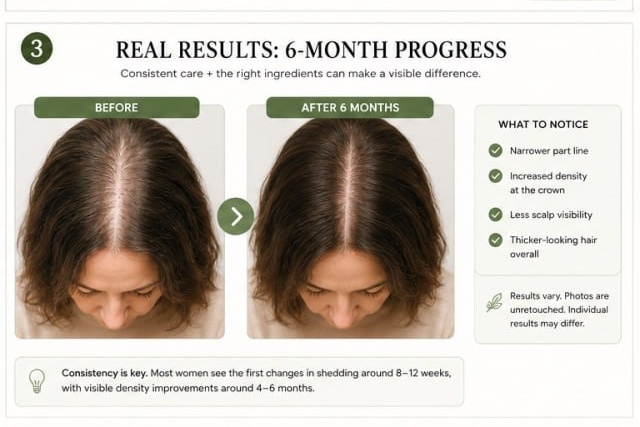
One of the biggest mistakes women make is giving up too soon. Hair growth cycles are slow, and hormonal hair loss took months (or years) to develop — it doesn’t reverse in weeks.
Weeks 1–4: Setup phase. Scalp may adjust to new products. Some initial shedding is normal (follicles shedding older strands to allow regrowth). Do not interpret early shedding as failure.
Weeks 4–8: Reduced shedding. Many women notice fewer hairs in the drain and on the brush. New growth may begin at the hairline or part line.
Weeks 8–12: Visible early results. Baby hairs (new growth) typically become visible around the hairline. Part line may appear fuller.
Weeks 12–24: Continued improvement. Hair texture and density keep improving as the growth phase extends and more follicles return to active production. The visible payoff usually lags behind the early shedding reduction, so patience matters here.
6+ months: Full assessment baseline. A fair evaluation of any natural hair growth regimen requires at least 6 months of consistent use. Before that, you’re evaluating a process that hasn’t had enough time to complete.
The key: Consistent, daily application is non-negotiable. Missing days significantly slows progress. Treat it like brushing your teeth — same time, every day.
Your Menopause Hair Loss Support Regimen
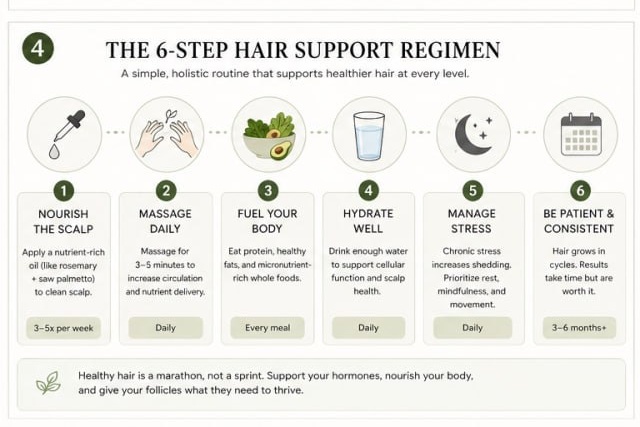
A complete approach addresses multiple factors simultaneously. Here’s how to actually execute each step:
1. Topical oil treatment
Use a rosemary + saw palmetto oil on a dry scalp — wet hair dilutes the formula and reduces absorption. Part your hair into 4–6 sections, apply 8–10 drops directly to the scalp across the crown and part line, then massage for 4–5 minutes with your fingertips. Leave it in overnight if possible. Sate Growth Oil is designed for this routine.
2. Bloodwork first
Before buying supplements, get a blood panel that includes ferritin (not just iron), vitamin D (25-OH), zinc, TSH (thyroid), and a CBC. Tell your doctor you want ferritin checked specifically for hair loss — request a target of 70+ ng/mL, not just “within normal range.” Supplementing blindly wastes money and can cause imbalances. Know your numbers first.
3. Scalp massage (if not combining with oil)
If you prefer to do scalp massage separately from oil application: use fingertips in small circular motions, start at the nape of the neck and work forward toward the hairline. Medium pressure — firm enough to feel resistance, not so firm it causes discomfort. 4 minutes daily is the protocol from the Koyama (2016) study that showed increased hair thickness after 6 months. Consistency matters more than technique.
4. Stress and sleep
Chronic elevated cortisol directly pushes hair follicles into the shedding phase. This isn’t generic wellness advice — it’s a documented physiological mechanism. Specifically: prioritize 7–8 hours of sleep (cortisol spikes with sleep deprivation), moderate-intensity exercise 3–4x/week (lowers cortisol, improves insulin sensitivity which affects DHT), and one genuine daily stress-reduction practice. Your hair cannot grow properly in a chronically stressed system.
5. Doctor conversation
Bring this up at your next gynecologist or dermatologist appointment: “I’m experiencing hair thinning and want to rule out thyroid, iron, and hormonal causes.” Ask specifically for ferritin, TSH, free T3, vitamin D, and zinc. If your symptoms are significantly affecting quality of life, ask about topical minoxidil or spironolactone as options — knowing your options doesn’t mean committing to them.
6. The six-month rule
No regimen — natural or pharmaceutical — produces results in 4–6 weeks. Hair grows approximately half an inch per month. Set a calendar reminder for six months from when you start. That’s your first honest evaluation point. Before six months, the only metric that matters is shedding reduction. If you’re losing noticeably less hair in the drain and on your brush by week 8, the regimen is working — density comes later.
Related Guides
Explore the complete Sate Haircare resource library for hormonal hair loss:
- Why Hair Thins After 40: The Science Behind the Change
- Perimenopause Hair Loss Causes: What’s Actually Happening
- Saw Palmetto for Women’s Hair Loss: Does It Really Work?
- Best DHT Blocker for Women’s Hair Loss: Natural vs. Pharmaceutical
- Rosemary Oil vs. Minoxidil: What the Research Actually Shows
- Best Hair Loss Treatment for Women Over 40: A Practical Comparison
- Hair Regrowth Products for Menopause: What Works and What Doesn’t
Frequently Asked Questions
Can menopause really cause hair loss?
Yes. Hormonal changes during menopause — specifically declining estrogen and progesterone combined with relatively increased DHT activity — directly affect hair follicle cycling. Up to 40% of women over 50 experience some degree of hormone-related hair thinning. It is one of the most common but least discussed menopause symptoms.
When does menopausal hair loss start?
For many women, hair thinning begins during perimenopause — sometimes as early as the mid-40s — when hormone levels first start fluctuating. Menopause symptoms like hair loss often continue or accelerate through the menopause transition. Some women notice a sudden surge in shedding; others see gradual thinning over years.
Does hair grow back after menopause?
It depends on how long follicles have been affected and how severely they’ve miniaturized. Hair follicles that are dormant but not permanently damaged can be reactivated with the right intervention. In general, the earlier you address hormonal hair loss, the better the outcome. Waiting years before treating reduces the percentage of recoverable follicles.
Is rosemary oil actually effective for hair loss?
Clinical research supports it. A 2015 randomized trial (Panahi et al.) found rosemary oil produced statistically comparable hair count improvement to minoxidil 2% over 6 months, with fewer side effects. The proposed mechanisms are improved scalp circulation and 5-alpha reductase inhibition (reducing DHT activity). Consistent topical application for 8–16 weeks is required to assess results.
What is DHT and why does it matter for women?
DHT (dihydrotestosterone) is a potent androgen hormone converted from testosterone by an enzyme called 5-alpha reductase. Women produce testosterone in small amounts, and DHT is also produced. When estrogen declines during menopause, DHT’s relative influence on hair follicles increases — in genetically susceptible women, this triggers follicle miniaturization and gradual thinning. Natural 5-alpha reductase inhibitors like saw palmetto may help manage this process.
How long does it take for natural hair loss treatment to work?
Most women see initial results (reduced shedding, early regrowth) between 8 and 12 weeks. A fair assessment of any natural hair growth regimen requires 4–6 months of consistent daily use. Density improvement takes time even when follicles are actively responding — see the Timeline section above for the full breakdown.
Should I see a doctor about menopausal hair loss?
It’s worth discussing at your next appointment, especially if: hair loss is sudden and severe, you have other symptoms (fatigue, weight changes, skin changes), you’re concerned about thyroid or iron issues, or hair loss is significantly impacting your quality of life. Bloodwork to check ferritin, thyroid function, and vitamin D is a reasonable starting point.
Can I use rosemary oil if I’m also on HRT?
There are no known contraindications between topical rosemary oil and hormone replacement therapy (HRT). They work through different mechanisms and target different aspects of hair health. If you’re on HRT or any prescription medication, confirm with your healthcare provider before adding any new supplement or treatment.
What’s the difference between perimenopause and menopause hair loss?
Both are hormonally driven, but perimenopause hair loss often presents more erratically due to fluctuating hormone levels, while menopause hair loss tends to be more gradual. Some women find perimenopause hair loss more alarming because the sudden shedding surges are unexpected. The treatment approach is similar for both.
Is $14 really enough to make a difference?
The effectiveness of a hair growth product depends on the active ingredients and how consistently you use it — not the price point. Sate’s Rosemary + Saw Palmetto Growth Oil contains the two most clinically supported natural ingredients for hormonal hair thinning at a formulation designed for daily topical use. The goal was to make an evidence-backed option accessible, not luxury-priced.
How do I know if my hair loss is from menopause or something else?
Menopausal hair loss typically presents as diffuse thinning across the crown, a widening part line, and smaller ponytail circumference — not patchy or circular loss. It usually develops gradually and coincides with other perimenopause/menopause symptoms. Patchy loss, sudden severe shedding, or loss accompanied by other symptoms (fatigue, skin changes, weight changes) warrants a medical evaluation to rule out thyroid disorders, iron deficiency, or autoimmune conditions.
About Sate Haircare
Sate Haircare makes the Rosemary + Saw Palmetto Growth Oil — a natural, DHT-targeted hair growth oil formulated specifically for women experiencing hormonal hair thinning during perimenopause and menopause. At $14, it is designed to make evidence-backed, pharmaceutical-free hair care accessible.
This article is for informational purposes only and does not constitute medical advice. If you are experiencing significant hair loss, consult a healthcare provider to rule out underlying medical conditions.
Last updated: June 2026 | Written by the Sate Haircare Editorial Team